
Anthropic raised money in May at $965 billion. The IPO is reported to be aiming at $2 trillion. Rather than ask what the company is worth, I asked what you would have to believe to pay those prices. The answer is a straight line.
Valuing a company that has never been priced by a public market is guesswork. The useful question is a different one. Take a disciplined model, the seven-driver shareholder value framework I have used on listed companies for years, and run it backwards. Instead of asking what the drivers produce, ask what the drivers must be to reach the price on the table.
I have spent the past few weeks arguing that the most dangerous assumption in AI is the straight line: that tomorrow’s AI will be a larger version of today’s, financed on a path that simply continues. I set that out in three essays: When Innovation Causes the Default, Monolithic Intelligence versus Governed Intelligence and The Division of Intelligence. This piece puts numbers on that concern.
The answer, in short: neither valuation is impossible. But each needs today’s kind of AI business to keep its shape, its growth and its margins into the 2040s. A $2 trillion price is a forecast about Anthropic. It is also a forecast about the architecture of AI, and it makes no allowance for a bend. A listing then hands that forecast to shareholders who made no decision about it.
What the leaked filing shows
The draft prospectus describes a company growing faster than almost any in history, while making commitments many times its revenue. These are the figures as Reuters and Fortune reported them.
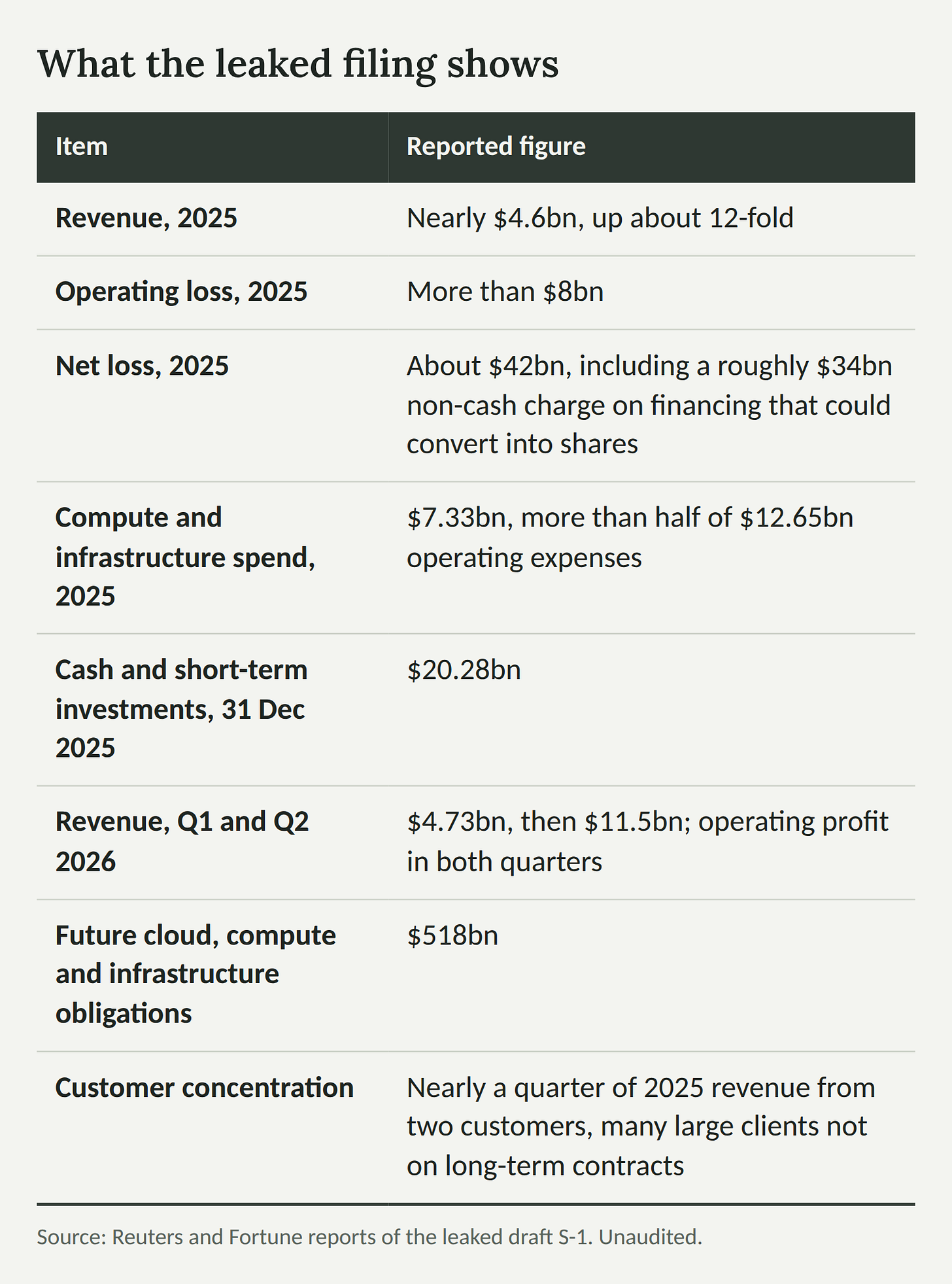
Two things stand out. Revenue more than doubled between the first and second quarters of 2026. And the $518bn of obligations is more than a hundred times last year’s revenue.
The first is the line everyone is extrapolating. The second is a commitment to the kind of computing that today’s models need. The whole valuation question lives in whether the two stay in step.
How I approached it
The model is Dr Andrew Black’s seven-driver framework: sales growth, operating margin, cash tax, fixed capital investment, working capital investment, the value growth duration and the cost of capital. Value is the present value of free cash flow over the duration, plus a residual. Once the duration ends, the residual assumes no further growth. That is deliberate: it forces you to say how long a company can keep earning above its cost of capital, rather than hiding it in a perpetual growth rate.
I made two adaptations for a company with no share price and no peers. I added a hypergrowth phase, because a standard model cannot cope with revenue that grew twelve-fold last year. And I took the cost of capital from Anthropic’s counterparties rather than a peer group: Nvidia, Microsoft, Amazon, Alphabet, Oracle, Broadcom and CoreWeave. They are its suppliers, investors, sales channels and, in some cases, creditors. That gives a cost of capital of about 13.7%. The full assumptions are in the appendix.
On my base case the equity is worth about $420bn. That is less than half the Series H price, the private-market valuation set in May, and about a fifth of the IPO target.
The base case is not cautious. It has revenue growing at 50% a year for four years and reaching about $560bn by 2036, comparable to the largest companies in the world today, at a 30% operating margin.
A fair objection is that the model is built to give a low number. The cost of capital includes a 1.5-point addition for a young company, and the residual allows no growth after 2036. That is why I do not rest on the base case. The reverse-solve relaxes each of those choices in turn and shows how far it has to go.
I remember Andrew Black telling me that during the dot-com boom he and his colleagues worried that the economics of shareholder value had broken down, because they could not get anywhere near the prices. After the collapse they concluded that the economics had held. The market had been engaged in a willing suspension of disbelief. I do not know that the same is happening now. But I recognise the symptom.
What each price requires
Running the model backwards asks a simple question: holding everything else at base, how far must one driver move to reach the price?
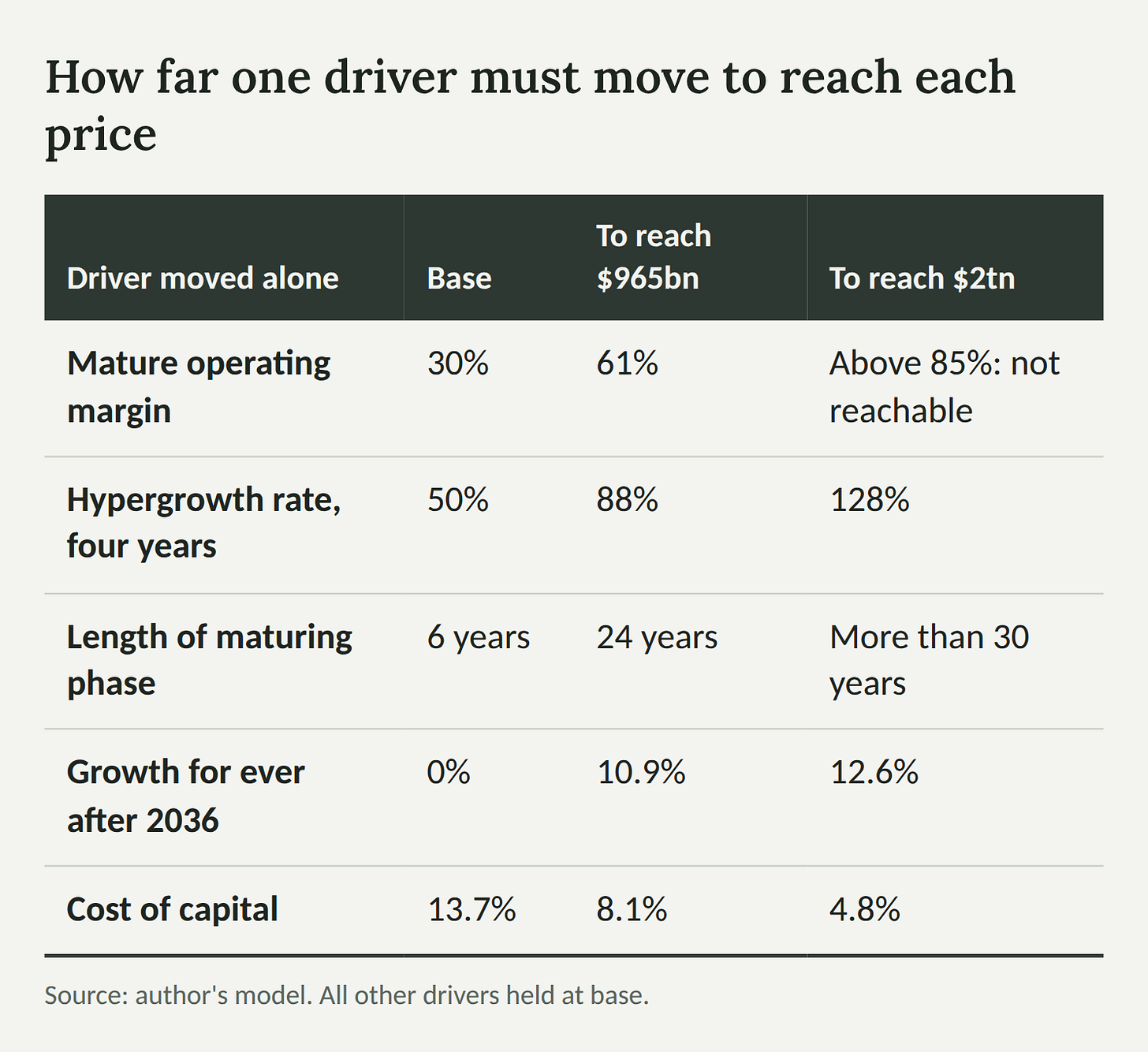
No single driver gets there on plausible terms. A 61% operating margin would match Nvidia, the most profitable business in the stack. A 4.8% cost of capital is below the current yield on US government debt.
Combinations are more realistic, so I tried two.
The Series H price. A 40% mature margin, close to the cloud businesses of Microsoft and Amazon. Hypergrowth of 65% for four years. Then, after 2036, growth of 4% a year for ever. Together, those produce about $970bn, with revenue of about $820bn in 2036. Demanding, but a coherent story.
The IPO target. A 45% margin, hypergrowth of 75%, a maturing phase of eight years rather than six, and a cost of capital of 11% rather than 13.7%. That reaches about $2 trillion. It also requires revenue of about $1.4 trillion by 2038, roughly twice Amazon’s sales last year. Every one of those assumptions sits at or beyond the top of my range at the same time.
Now look again at the third row of the table. To reach the Series H price on time alone, the maturing phase has to stretch from six years to 24. Time is the weakest lever in the model. That is worth a section of its own.
When the value arrives
A valuation model discounts the future. At 13.7%, a dollar earned in 2036 is worth 28 cents today. A dollar in 2046 is worth 8 cents. A dollar in 2056 is worth 2 cents.
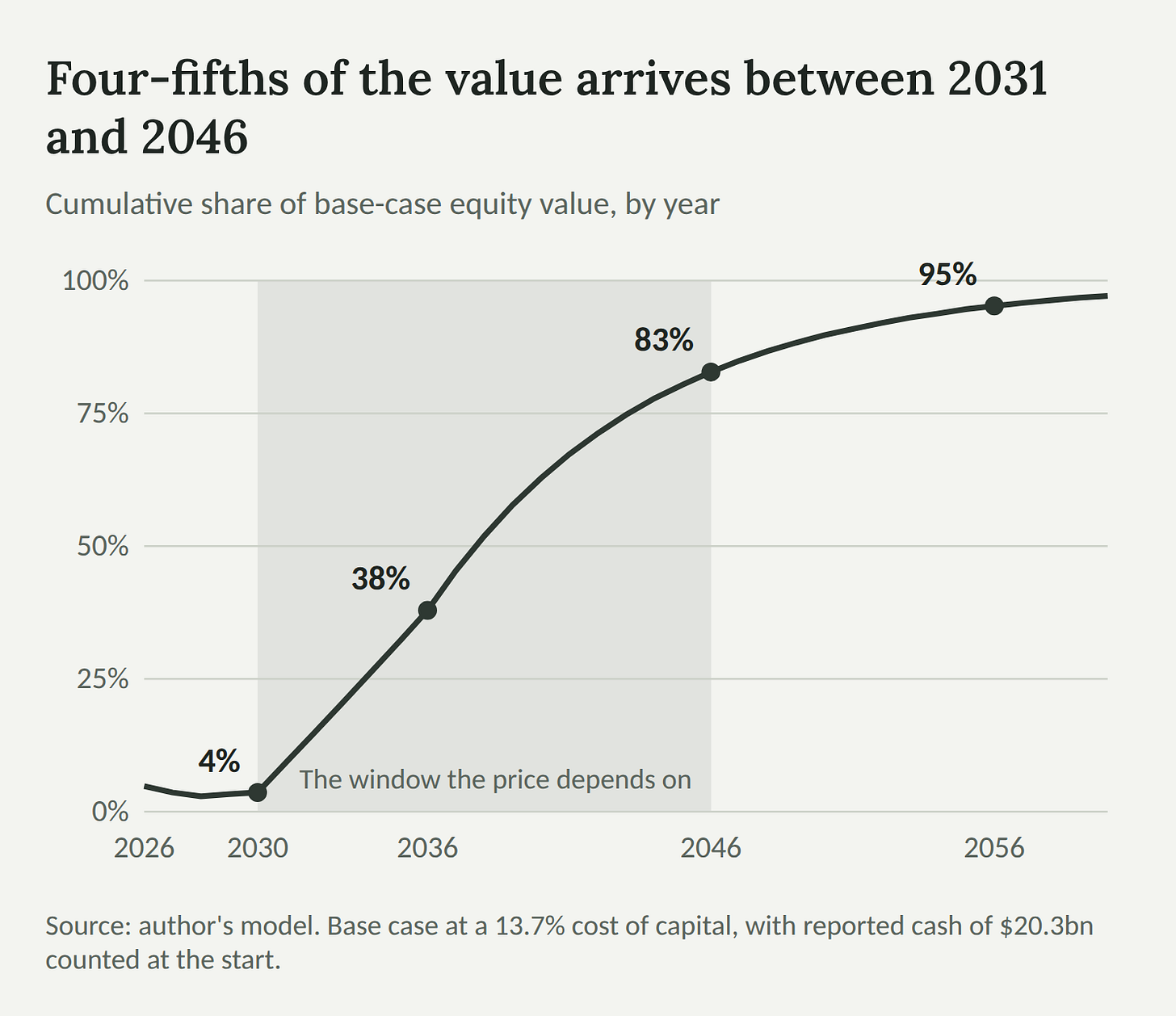
That has two consequences, and neither fits the usual way of talking about these companies.
The first is that the next four years contribute surprisingly little direct value. In my base case Anthropic spends about as much on growth as it earns until 2030. Those years matter for a different reason: they decide the height from which the valuable period begins.
The second is that the distant future counts for little. These prices cannot be justified by what happens in the 2050s. The discount rate will not allow it.
So buyers at these prices are not paying for the cash flows of the next five years, and they are not paying for some far horizon. They are paying for a particular window, roughly 2031 to 2046. The business has to arrive there at a great height and then hold it.
In the first Straight Line essay I wrote that the useful life of the financing and the competitive life of the asset are moving on radically different clocks. The same is true of the price. It runs on a clock of fifteen to twenty years. The technology develops in months.
One more point about my own base case. More than 60% of its value comes after 2036, where I assumed no growth. But no growth is not the same as no assumption. The model takes the profits of 2036, at a 30% margin, and continues them for ever. That is a straight line too. It just happens to be a flat one.
The bend the price ignores
In the first of the Straight Line essays I argued that the AI industry can succeed while its financial architecture fails. We are financing long-lived infrastructure against a short-lived conception of how artificial intelligence will work. If AI becomes cheaper, smaller and more specialised, the event that causes the default also destroys the value of the collateral.
The same argument applies to equity. Both prices need margins of 40% or more, held through the 2030s and into the 2040s. Margins like that belong to a supplier its customers cannot replace. In the third essay I called that position the intellectual landlord: one, two or three universal models sitting behind our businesses and public services, with their owners controlling the price and conditions of access. A 45% margin is the landlord’s rent.
I have argued that intelligence may not work that way. It may be less like a ladder and more like an economy: specialist by default and generalist by exception. The largest models will not disappear, but their role may be narrower than their builders currently assume. In the second essay I suggested the large model becomes the appellate court, not the magistrates’ court hearing every case. And customers who can replace a supplier do not pay it rent.
I do not know that AI will bend in that direction. Nobody does. My point is narrower. The price assumes that it will not: that the appellate court goes on hearing every case.
So I asked what the model says if it does. What follows is an illustration, not a forecast. Suppose that at some date growth stops. Then suppose margins either hold at 30% or settle at 15%, the level of a good business that customers can leave.
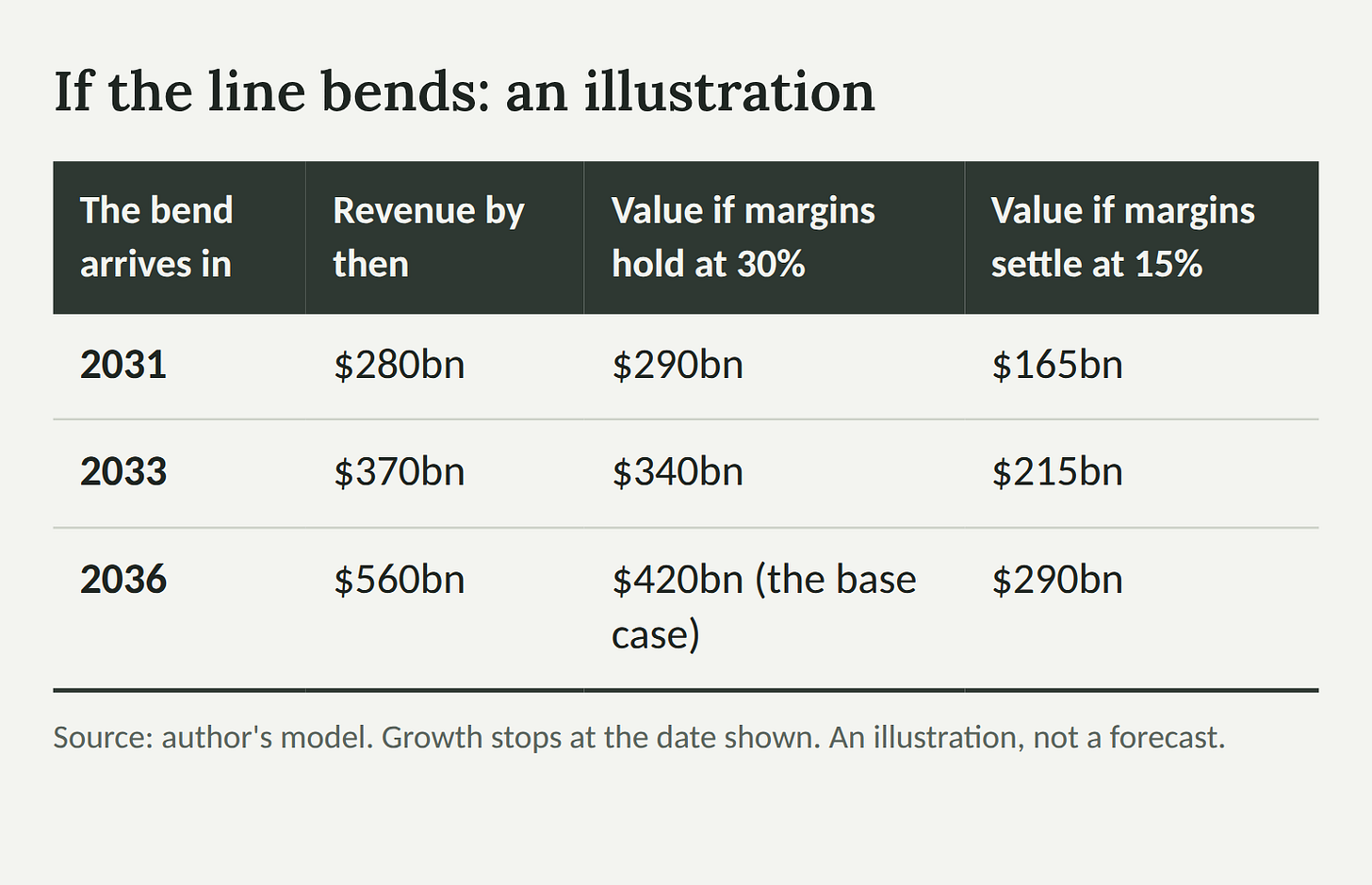
These are not gloomy scenarios. Each has revenue growing at 50% a year until 2030. Yet a bend inside the window leaves the equity worth between about 8% and 15% of the IPO target.
I then ran the reverse-solve again. If the bend came in 2033 and margins settled at 15%, what would revenue have to be by then to justify the prices? About $2.1 trillion for the Series H price, which means growing at more than 130% a year for four years. For the IPO target it is about $4.6 trillion. Neither price can be reached that way.
These figures leave out the $518bn. I cannot simply deduct it from the equity value. We do not yet know its timing, how flexible it is or what revenue it supports, and some of it is already reflected in the compute costs in my model. But neither can it disappear in a bend. Spending rises and falls with growth. An obligation does not. If the architecture bends, Anthropic could still owe for capacity designed for the old one, at the moment its customers prefer the new one. As an illustration only: if a quarter of the $518bn had to be paid for capacity it no longer needed, that would be about $130bn before discounting.
In the appendix I test the usual vulnerabilities one at a time: commoditisation, a compute squeeze, lost customers, a higher cost of capital. Seen through the bend, they are not separate risks. A cheaper architecture would cut margins, strand the commitments, loosen customers who are not on long-term contracts and raise the cost of capital, all at once. In my first essay, the event that causes the default also destroys the collateral. Here, the event that slows the growth also removes the margin.
The twist is that none of this requires AI to disappoint. It only requires AI to improve in a direction the price did not allow for. Nor does it require Anthropic to fail. It may well be among those who build the specialised, governed alternative. A company can survive a bend that its price cannot.
Who inherits the line
This is the part that concerns me most. The risk I have described is not new. What a listing changes is who carries it. I raised this in the first essay, under the heading “From private fortunes to public pensions”. The leaked filing lets me say what is being handed over, and at what price.
Who has carried it so far. Until now the risk has sat with venture funds, sovereign wealth funds and the hyperscalers’ own balance sheets. They chose it. They can price it, and most can absorb a loss. Most of them also bought at prices well below the one now proposed.
What the new shareholder buys. An IPO at $2 trillion sells the same business at the highest price it has ever carried. The buyer acquires a residual claim on a business carrying $518bn of future obligations, at a price that assumes nothing bends before the mid-2040s. The buyer also inherits financing agreed earlier with someone else: most of the $42bn net loss in 2025 was a $34bn charge on instruments that could convert into shares.
What the listing does for the company and its backers. A flotation gives Anthropic a large cushion of permanent capital, which reduces its immediate liquidity risk. That is a real benefit. It also gives the earlier holders a market in which to sell. I do not suggest they will rush to use it. But the ability to pass the risk on is valuable, and it is created by the same event that sets the price at its highest.
Where the risk ends up. In time, through index inclusion, the shares reach passive funds and pension schemes. The fund provider follows the index. The ultimate investor makes no decision about the company at all. And because the index weights by price, the higher the price, the more the fund must buy. SpaceX has already listed at $1.77 trillion. Anthropic and OpenAI would follow. Three of the largest listings in history, all priced on long-dated technology bets, would arrive within a year.
I have written elsewhere that risk appetite is revealed in behaviour, not in documents. The early investors’ behaviour revealed an appetite they had chosen. Here the appetite is delegated. The trustee chose an index strategy, the member chose a fund and the index provider chose its rules. Each decision was reasonable. Yet the exposure arises without anyone making an explicit risk-appetite decision about Anthropic itself. The listing hands over a risk, and with it an appetite that nobody has stated.
Diversified by issuer, concentrated by assumption. Anthropic’s $518bn of obligations are revenue in its suppliers’ order books, and Amazon and Google are both its investors and its cloud providers. I described that circle in the first essay, and there is nothing improper in it. But it means the lab, its chip supplier and its cloud providers look like separate holdings in an index fund while resting on one assumption: that frontier models keep their central place and their appetite for compute. In the first essay I described a portfolio with four borrowers but only one underlying bet. This is the equity version of it.
A successful flotation would be presented as evidence that the risks were receding. It might instead complete a move from concentrated private risk to widely distributed public risk.
The timing matters most. Most crises begin when the next provider of finance declines to endorse the assumptions made by the last one. At an IPO the next provider of finance is the public, and it is being asked to endorse those assumptions at about twice the price paid in May.
The value arrives between 2031 and 2046. Those are the years that will show whether the line held. By then the early investors will have had every opportunity to reduce their exposure. The people holding the risk through the years that decide the outcome will be the ones who paid the most and chose the least.
Cisco is a better comparison than the dot-com failures. In 2000 it was a real, profitable company at the centre of a genuine technology shift. It went on to succeed. Shareholders who bought at the peak still waited more than two decades to get their money back. The business was right; the price was not.
Where the map ends
I also ran 10,000 simulations, drawing each driver from the ranges in the appendix. The middle 80% of outcomes runs from about $245bn to $750bn, with a median of about $435bn. Only about 3% of runs reach $965bn. Reaching $2 trillion happened once in 10,000.
It is tempting to lead with that last number. I have put it here instead, because the claim is greater than is justified. A simulation can only draw from the ranges I give it. It varies the slope of the line. It never asks whether the line bends. A stress test which merely confirms the assumptions embedded in the base case is not a stress test.
John Adams calls risks of this kind virtual: matters where knowledge is lacking, or experts cannot agree. The future architecture of AI is a virtual risk. You cannot set a limit for something you have not yet imagined, and you cannot put a probability on it either.
So the honest reading of “once in 10,000” is not that $2 trillion is nearly impossible. It is that the price lies beyond anything I can support with evidence. So does the bend. The old cartographers had an honesty about this. Where their knowledge ran out, they wrote “Here Be Dragons”. A chart of 10,000 runs has no such margin. It looks beautifully complete.
That uncertainty cuts both ways. There is another kind of bend my model cannot see. Anthropic could discover businesses more valuable than the one I have modelled: in agents, in the workflow of large organisations, or in markets that barely exist today. A reverse valuation cannot price an option nobody has yet invented. A buyer who is paying for that option should say so, because it is a different belief from the one in the spreadsheet.
The more telling number is in the reverse-solve. If every other assumption in my base case is held constant, the $2 trillion price can only be reconciled by discounting Anthropic’s future cash flows at 4.8%, below the current yield on US government debt. That is not a credible explanation on its own. So buyers must be assuming some combination of faster growth, higher margins, a longer run and lower risk. Each of those is a judgement about how much uncertainty to accept. Taken together, they are the risk appetite the price reveals.
An assumption can be written down and tested. A belief can at least be stated. Hope is what is left when neither has been done. Johnson called a second marriage the triumph of hope over experience. A price that needs every assumption at the top of its range at once may be the triumph of hope over evidence.
In Here Be Aliens I described a board in which each director hears “AI risk”, nods at “low” and believes the room has agreed, though each has something different in mind. A market can do the same with a price. Everyone nods at $2 trillion. Each buyer may be assuming something different about margins, growth and time. Nobody checks.
The questions to ask
None of this says Anthropic is overvalued. It says what a buyer at $965bn or $2 trillion must believe: margins at the very top of the technology industry, growth sustained through the 2030s, and no change in the kind of AI the world wants to buy until well into the 2040s. Some of that may prove right. The point is to know which beliefs you are buying, and whether you chose them.
When the S-1 appears on EDGAR, four things will tell us most.
How the $518bn of obligations is scheduled, how much can be cancelled or deferred, and how much is tied to today’s architecture.
Gross margin and its trend, which shows whether margin is being earned or bought.
The share count after conversion of existing financing, and what existing holders may sell and when.
Contract terms with the largest customers, and how much revenue flows through Amazon and Google.
OpenAI is the obvious comparison, but its confidential filing has not leaked. It was valued at $852bn in March on far less public information, which is a risk in itself.
I will update this analysis once the official figures are released.
Artificial intelligence may fulfil much of its promise. It may become cheaper, smaller, more specialised and more useful. That would be good for almost everyone who uses it.
It would not be good for a price that assumed otherwise.
Appendix: the model
Assumptions. The base case drives the headline numbers; low and high bound the simulation.
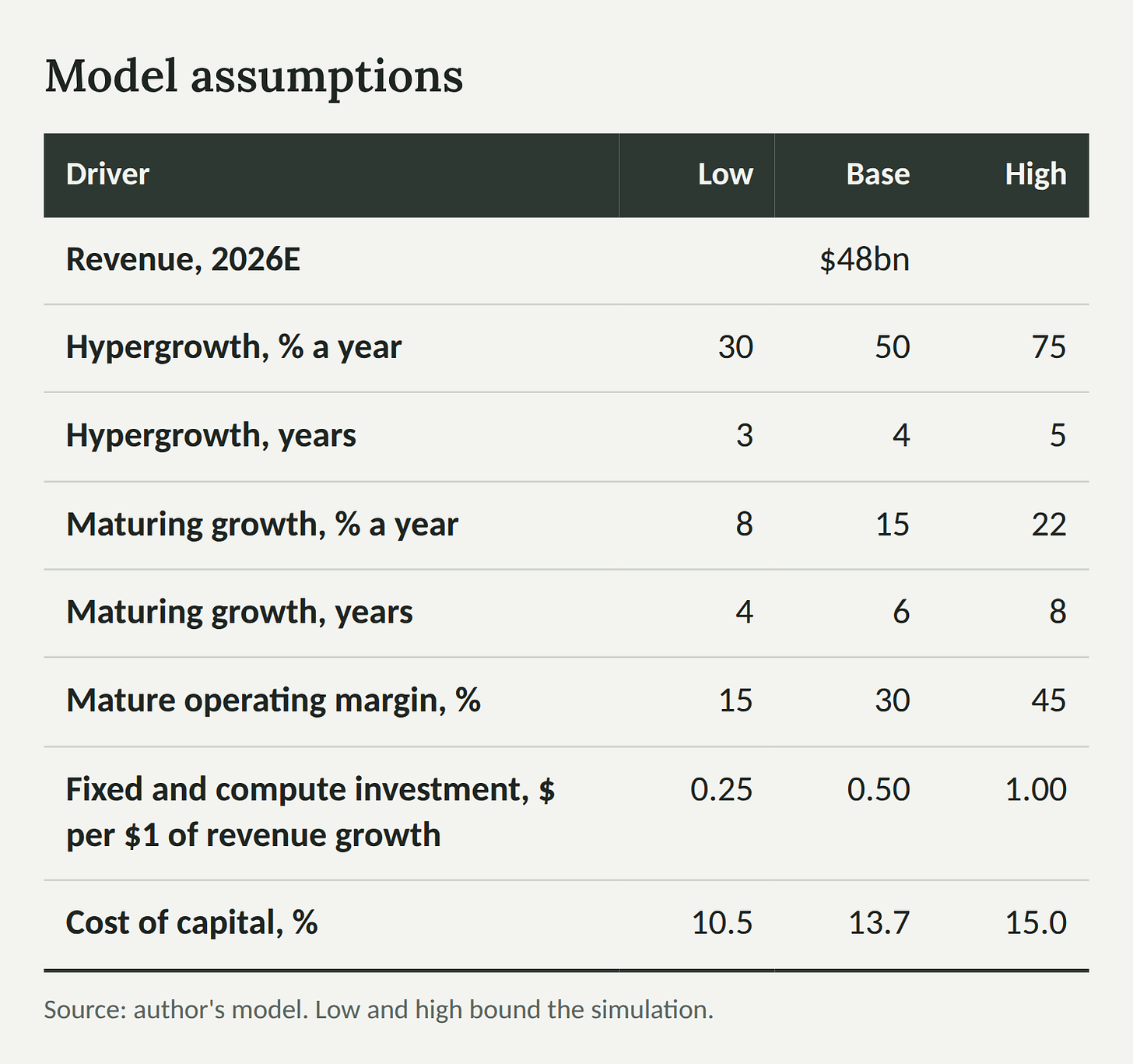
The 2026 revenue figure assumes the second half roughly doubles the first, as Q2 did on Q1. The margin starts at 5% and reaches its mature level over five years. There is no cash tax for three years, then 23%, as accumulated losses are used up. Working capital adds five cents per dollar of growth.
Cost of capital. There is no listed AI lab to compare with, so I used the average beta of the ecosystem cohort, about 1.4. With the US 10-year Treasury around 5.25%, a 5% equity risk premium and 1.5 points for illiquidity, governance and customer concentration, that gives about 13.7%. Debt is negligible, so this is also the WACC. It is a judgement, not a measurement: there is no beta and no trading history.
Base case. The next ten years of free cash flow are worth about $140bn today. The residual after 2036 is worth about $260bn, and reported net cash adds $20.3bn. That makes about $420bn.
Vulnerabilities taken one at a time. Each scenario moves the drivers shown against the base case.
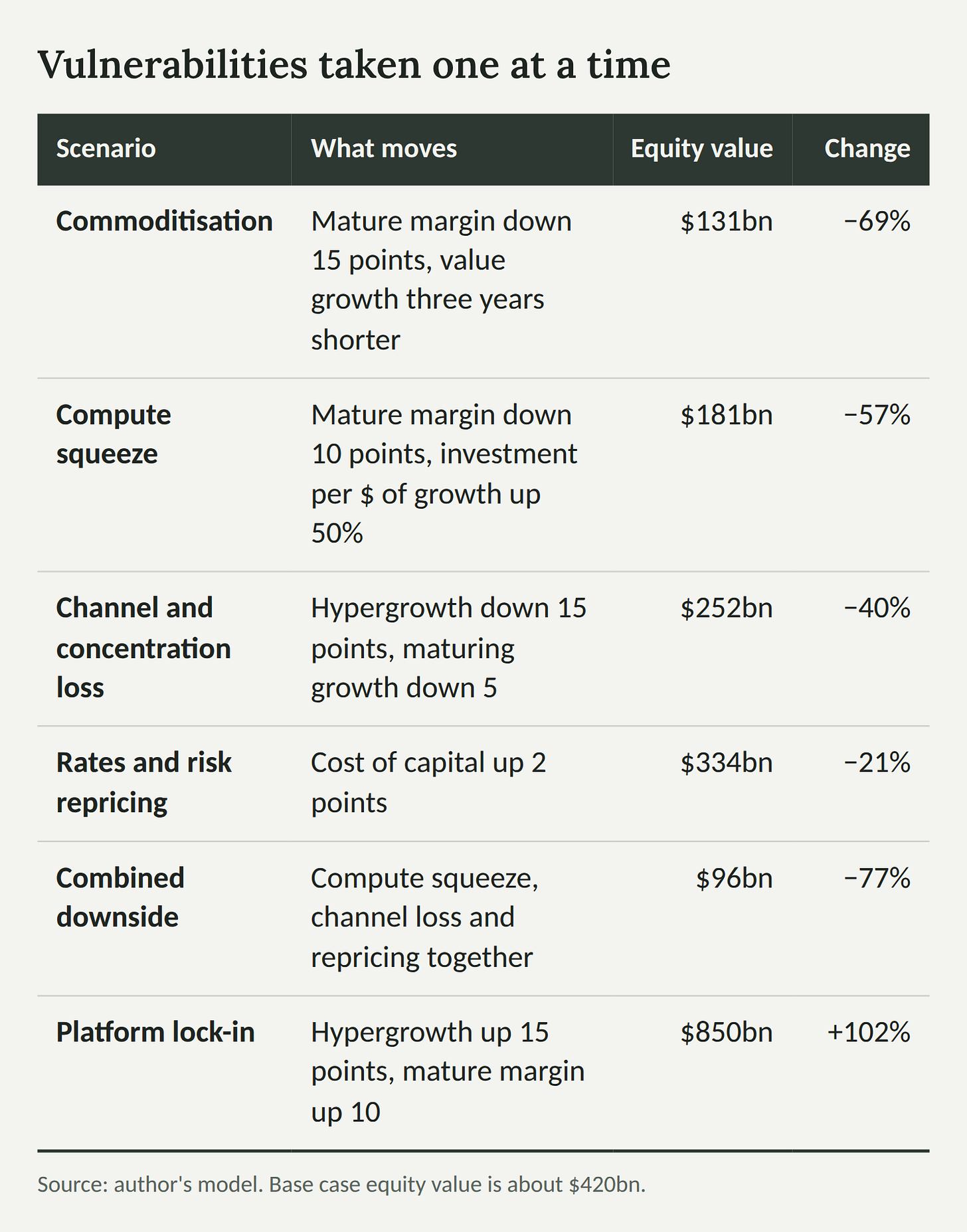
Margin is the largest single exposure, and nobody can observe the mature margin yet. Model prices have fallen steadily, and OpenAI, Google, Meta and xAI are all competing for the same customers. Amazon and Google are investors and channels to market, and both build competing models.
The bend scenarios. Growth follows the base case until the date shown and then stops. Margins ramp as in the base case until that date. Afterwards profits continue for ever at either the 30% base margin or 15%. The $518bn of obligations is not modelled, because its schedule has not been reported.
Simulation. 10,000 runs, each driver drawn independently from its low to high range. Independence understates the extremes: in reality, a company that grows faster also tends to earn higher margins and look less risky.
Governance and politics. Anthropic is a public benefit corporation, structured to put its mission alongside shareholder returns. More than a third of the draft filing reportedly covers risk factors, including the behaviour of its own models. A Pentagon blacklisting was only overturned in court in August.
Richard Anderson
Founder, AndersonRisk
This essay was first published on 7 October 2026 on my Substack.