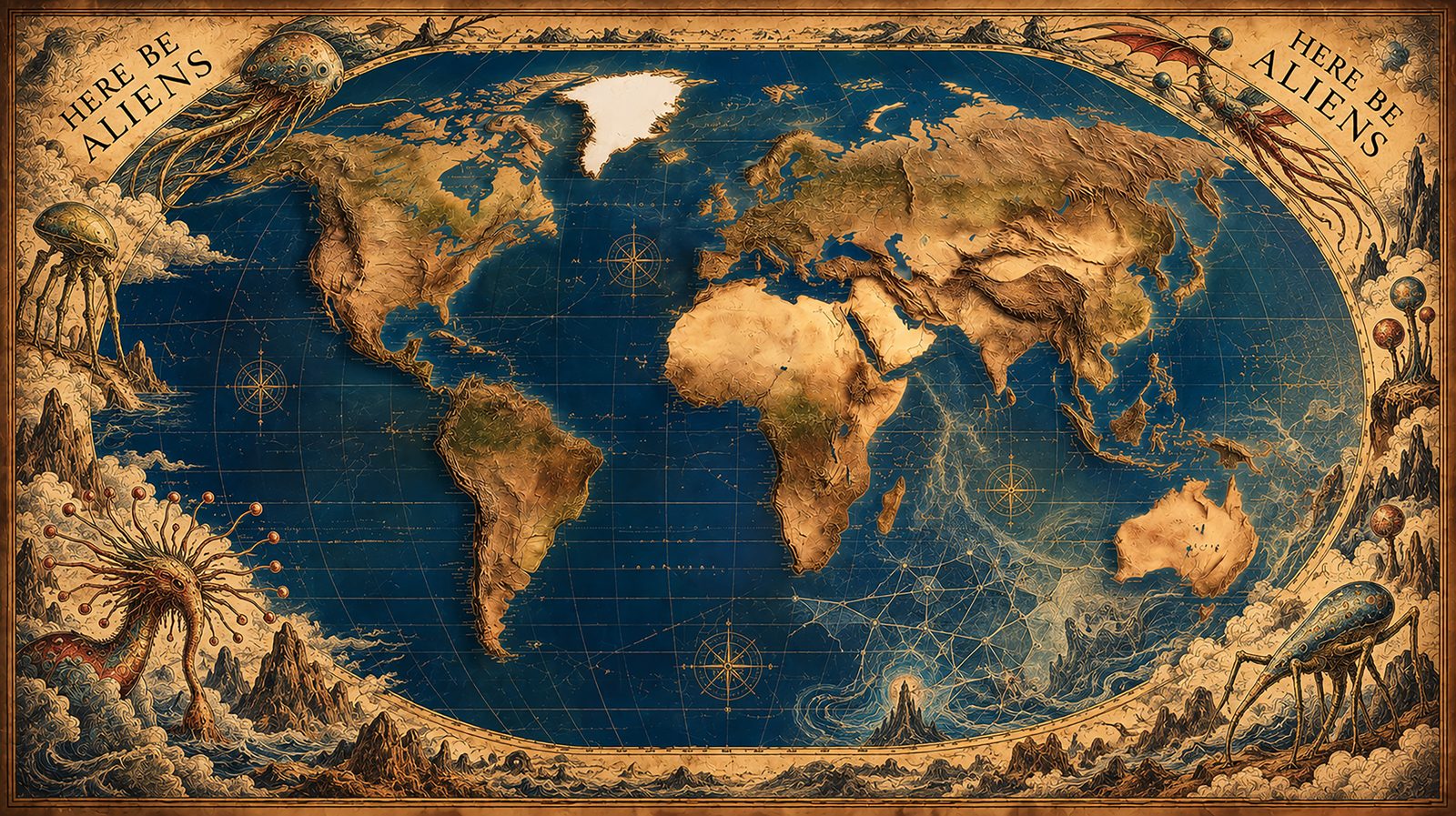
In an earlier article, I borrowed the warning sometimes attributed to old cartographers: “Here Be Dragons.” John Adams calls risks of this kind virtual: matters where knowledge is lacking, or experts cannot agree. The dragons did not need to exist for the uncertainty beyond the map to influence how people sailed.
Perhaps the modern map should say: “Here Be Aliens.” There is a small joke hiding in the word, but also a serious question. We cannot know everything AI will make possible, or what an organisation might become as it builds AI into its decisions. Like the dragons, our aliens give shape to something we do not yet understand.
I have sat in boardrooms and with clients talking about AI risk appetite. I know the pressure on directors to agree and move on. The agenda is long, and a statement that everyone can live with feels like progress. Nobody wants to be the one still asking questions when the next item is waiting.
But what have they agreed to? One director may be thinking about an AI system inventing an answer. Another may picture a customer receiving a decision that takes no account of her circumstances. A third may have in mind a model provider the organisation could not replace without serious disruption. Each hears “AI risk,” nods at “low,” and believes the room has agreed. Nobody checks, because checking takes the extra ten minutes nobody has.
Technical assessments can tell us how a model performs against particular tests. The board also needs to understand how its systems depend on that model, and what happens as people adapt their work around it. Those questions cross disciplines. No single specialist’s report can answer them all.
Much of my work on risk culture concerns the conversations through which an organisation discovers what it knows. Who talks to whom about AI, and about which decisions? How often? Do they consider those conversations good? I have asked boards whether an uncomfortable observation has ever changed a decision, and watched the room pause before anyone answered. The pause can be revealing in itself.
The written record offers another view. A board paper may say there is “human oversight.” I have asked the person providing it what she can actually see and do. I have pushed on that phrase more than once. Sometimes she can see the answer but not how it was reached, has little time to investigate, and cannot stop the process. The paper and the practice describe different things. The board needs to understand that gap.
This is why I am wary of pressing for alignment in one meeting. A director who says, “I am not sure we mean the same thing by low appetite,” has given the board something valuable. The question may take several meetings and further investigation to resolve. Some questions will remain open much longer.
Boards are used to reaching a conclusion before moving on. With AI, they may need to keep a question alive: record the disagreement, establish what evidence would help, and return to it as the organisation learns. A discussion can be productive without producing a common view.
The organisation need not stand still. It can find out where AI is used, establish who can challenge a consequential decision, and preserve the ability to operate without a particular provider. It can experiment within bounds while keeping major commitments reversible. That is work it is unlikely to regret.
None of this completes the map. Some risks can be tested; others remain disputed or beyond our present imagination. Better risk conversations help us see where the map ends. The old cartographers left space for dragons. We should leave space for aliens too, especially when the board pack looks beautifully complete.
I would be interested to hear how other boards keep uncertainty in view while still making decisions about AI.
Richard Anderson
Founder, AndersonRisk
This essay was first published on 27 September 2026 on my Substack.