
SpaceX listed in June at $1.77 trillion and is now worth about $2.3 trillion. Running the same reverse valuation approach that I used on Anthropic, my model can account for about a ninth of that. The price turns out to have a precise meaning: it is roughly what you get if management delivers its own target of $1 trillion of revenue by 2030.
In my last piece I asked what you would have to believe to buy Anthropic at $965 billion or $2 trillion. This is the sequel, and the obvious comparison. SpaceX absorbed Elon Musk’s xAI, and with it the X platform, in February. It was the first of this year’s giant AI listings.
It is also a cleaner exercise. The Anthropic numbers came from a leaked draft. SpaceX’s come from a prospectus and a first quarterly report filed with the SEC. And here I can do something I could not do with Anthropic: compare what the model said at the IPO with what the market has done since.
The two cases turn out to be different in kind. Anthropic’s price requires extreme assumptions about a business we can see. SpaceX’s price requires businesses we cannot yet see.
The seven-driver model values SpaceX at about $250 billion. The market pays about nine times that. Since the IPO the business has grown faster than anyone forecast, and in the model almost all of that improvement has been absorbed by the cost of achieving it.
What the prospectus showed
The prospectus splits SpaceX into three businesses. In 2025 they looked like this.
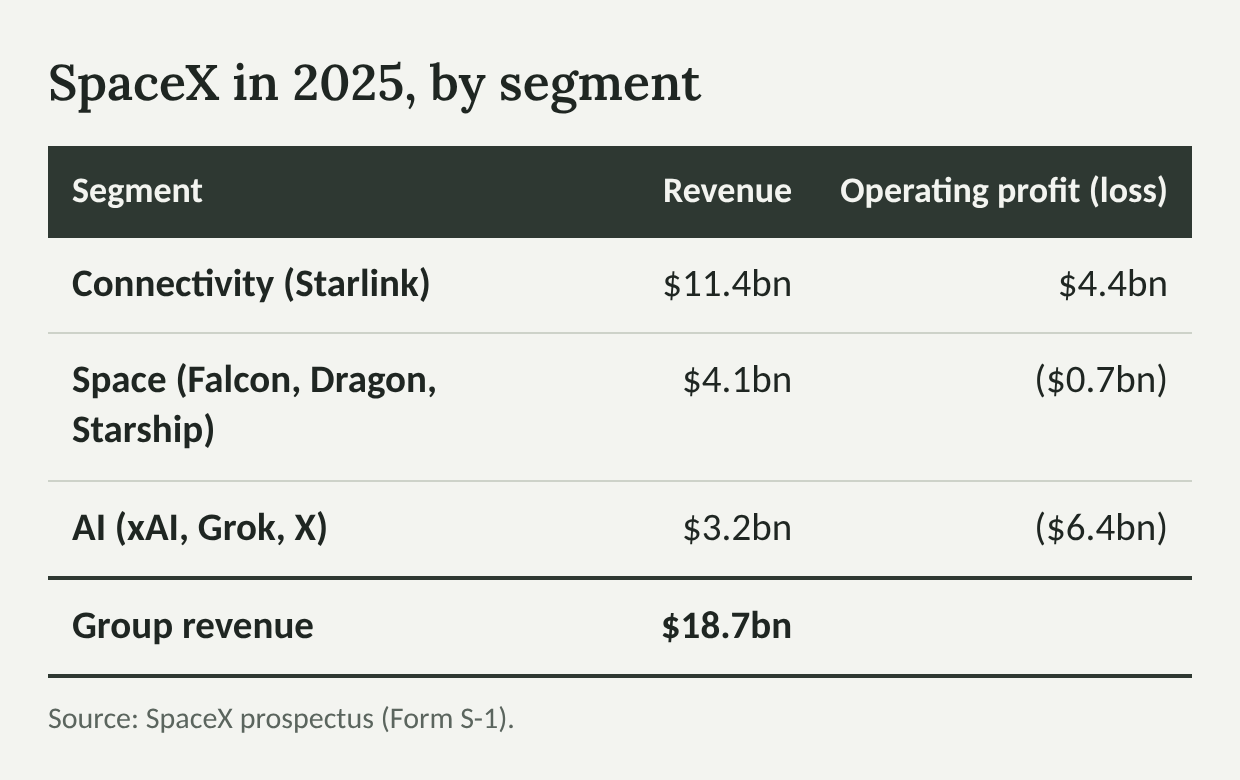
Starlink is the engine: the only segment in profit, on a margin of 39%. The Space segment lost money because of spending on Starship. The AI segment lost two dollars for every dollar of revenue.
Capital spending tells the same story. Of $20.7bn spent in 2025, about $12.7bn went on AI infrastructure. The group made a net loss of $4.9bn, against a profit of $791m the year before.
The shares were priced at $135 on 11 June and began trading the next day. That valued SpaceX at $1.77 trillion, about 94 times 2025 revenue. With the over-allotment, the offer raised $85.7bn net. Mr Musk kept more than 80% of the votes.
The approach, and one crucial difference
The model is the same as before: Dr Andrew Black’s seven drivers, with a hypergrowth phase added, a margin that ramps up to a mature level, and a residual that assumes no growth once the value growth duration ends. The cost of capital again comes from the ecosystem cohort of Nvidia, the cloud providers, Oracle, Broadcom and CoreWeave, at about 13.2%. That is half a point below Anthropic’s, because SpaceX is listed and liquid. SpaceX’s own beta is no help: after four months of trading, TradingView quotes a figure above five, which says more about a short and violent price history than about risk.
One difference matters more than any assumption. Anthropic rents its compute; SpaceX owns its. Anthropic’s cloud bills sit inside its operating costs, so they reduce its margin year by year. SpaceX buys the data centres, the chips and the satellites. In this framework that is fixed capital investment, and it comes out of free cash flow as it is spent. The same economic activity looks very different depending on who owns the asset.
These are the assumptions, first with what was known at the IPO and then as they stand today.
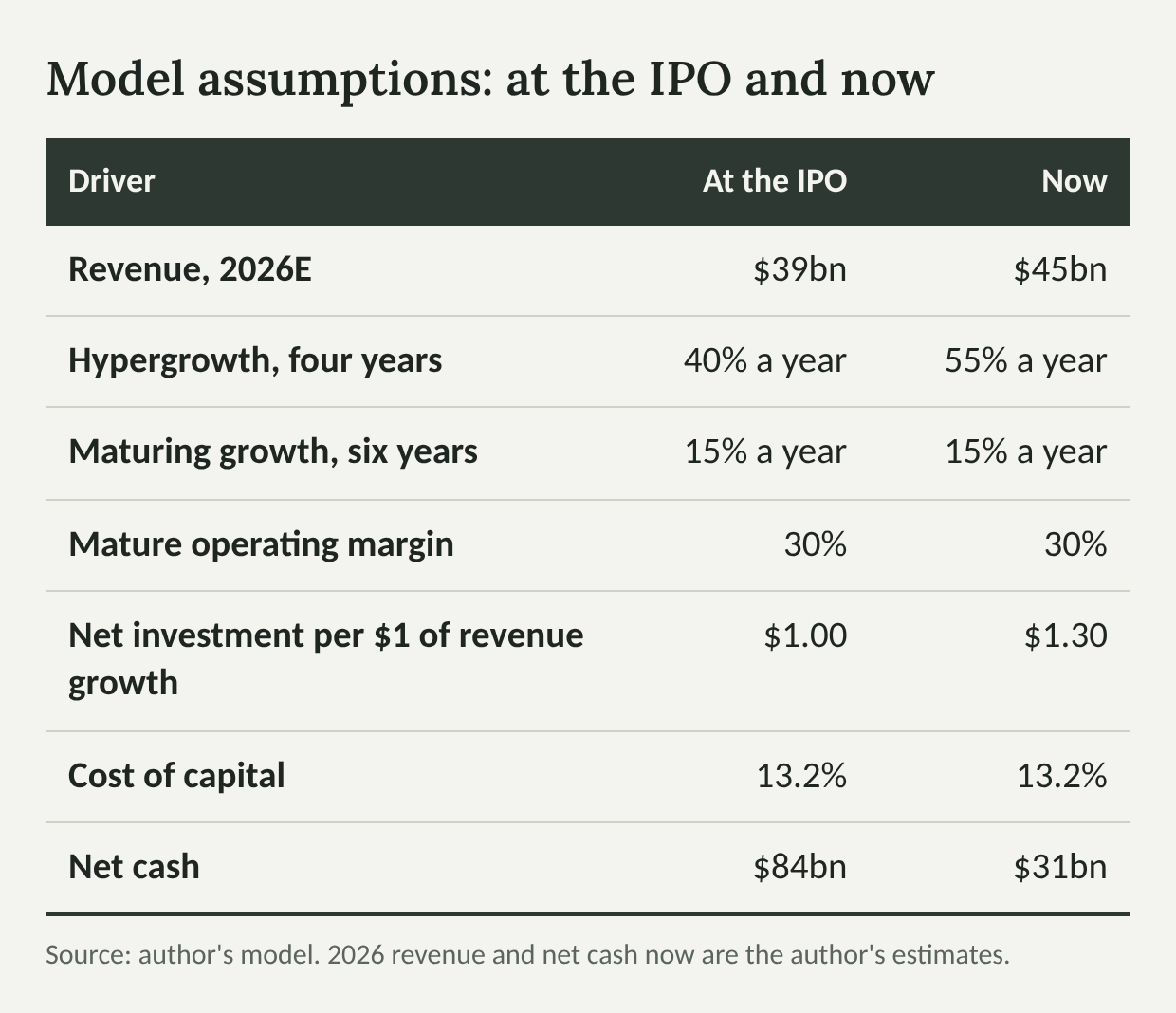
The mature margin of 30% sits below Starlink’s 39%, because launch and compute rental will not earn as much as broadband. No cash tax is paid for four years while past losses are used up, then 23%.
Net cash needs a word. At the end of June SpaceX held $100bn of cash and securities against $39bn of debt. I have taken off about $30bn for what I estimate it will spend, net, in the second half of this year.
The value at the IPO
On the information available in June, the base case gives an equity value of about $270bn. That is less than a sixth of the IPO price, and $84bn of it is cash, most of which the IPO itself had just raised.
The base case is not mean. It has revenue growing from $39bn to almost $350bn by 2036, larger than Microsoft today, at a 30% margin. But investment runs ahead of profit for most of that decade, so the next ten years add almost nothing. About 95% of the value of the business lies in the residual after 2036.
That is worth saying explicitly. In this model SpaceX consumes cash while it builds the asset, and nearly all the value sits in the finished asset. For Anthropic the equivalent figure was about two-thirds.
Across 10,000 simulations, drawing every driver from a wide range, the middle 80% of outcomes ran from about $140bn to $370bn. None reached the IPO price.
Running the model backwards makes the point more acutely.
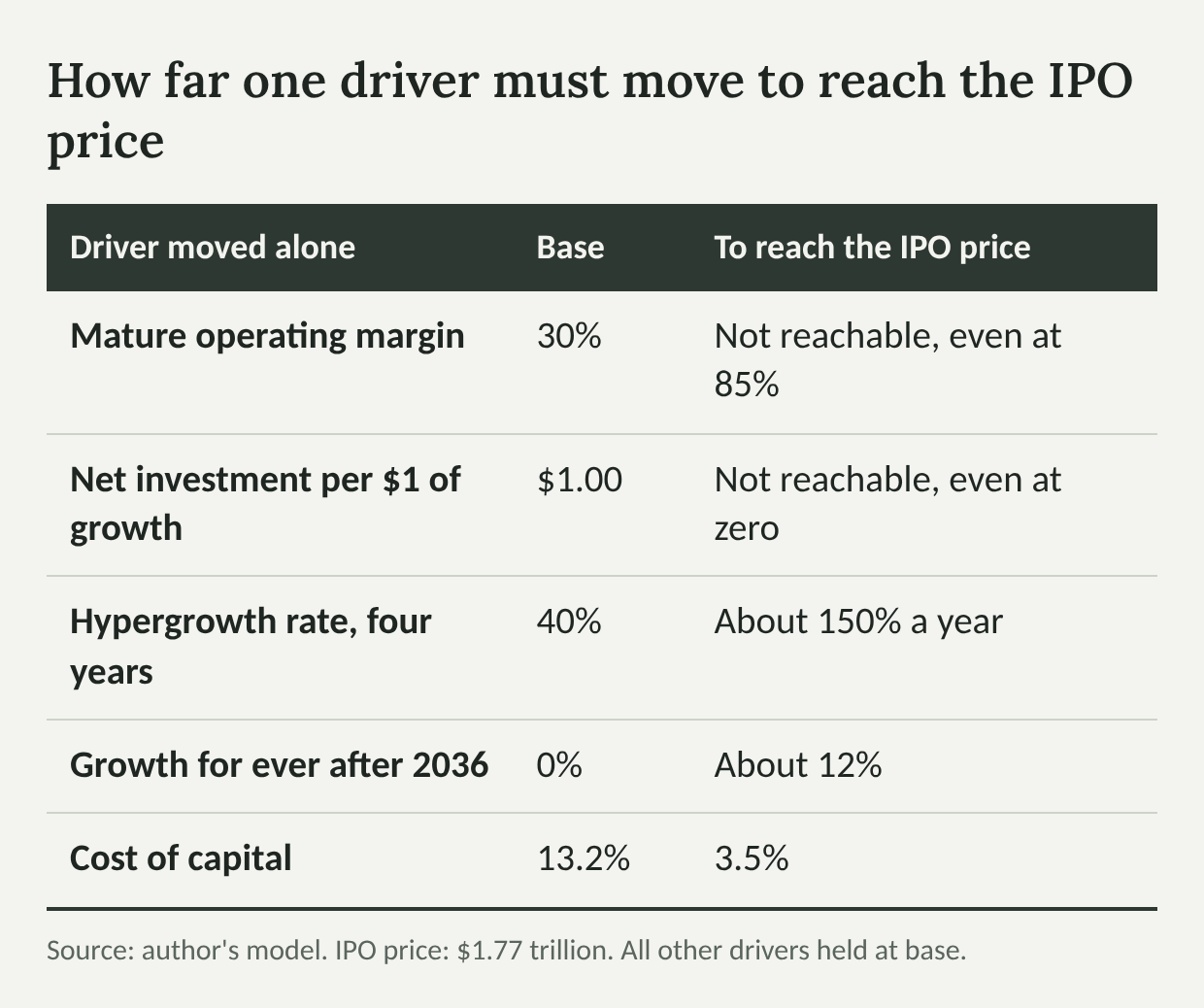
With Anthropic, a single driver could reach the Series H price on stretched but recognisable terms. Here none does. The IPO price can be reproduced mathematically, but not with assumptions I would call a forecast of the businesses visible today. The market was pricing something else.
Some will say 13.2% is too high a cost of capital, and that analysts use something nearer 10%. At 10% the June value rises to about $410bn. The gap narrows; it is not eliminated.
Since the IPO
The shares have had a wild four months. On 16 June they touched $225.64, valuing the company at almost $3 trillion. In early August they fell to $104.83, well below the offer price. They now trade at about $172, a market value of about $2.3 trillion. On 1 October it was $2.0 trillion.
The second-quarter results, the first as a public company, beat expectations. Revenue rose 92% to $7.8bn. Starlink reached 12 million subscribers, double a year earlier. AI revenue more than tripled to $2.6bn on new cloud contracts.
The ambitions grew faster than the results. Management now expects December’s revenue, annualised, to reach $100bn, and has brought forward to 2030 its target of $1 trillion of annual revenue. Four compute contracts stand behind the near-term figure: Anthropic at $1.25bn a month, Google at $920m a month from October, and two undisclosed customers starting in October and December.
The spending grew faster still. Capital spending was $18.4bn in the quarter, $15.8bn of it on AI compute. Over the first half, operations generated $3.5bn of cash while capital spending ran to $28.5bn. The difference came from the IPO proceeds and a $25bn bond. In August SpaceX also completed the purchase of Cursor, the AI coding company, for $60bn in new shares.
I updated the model for all of this.
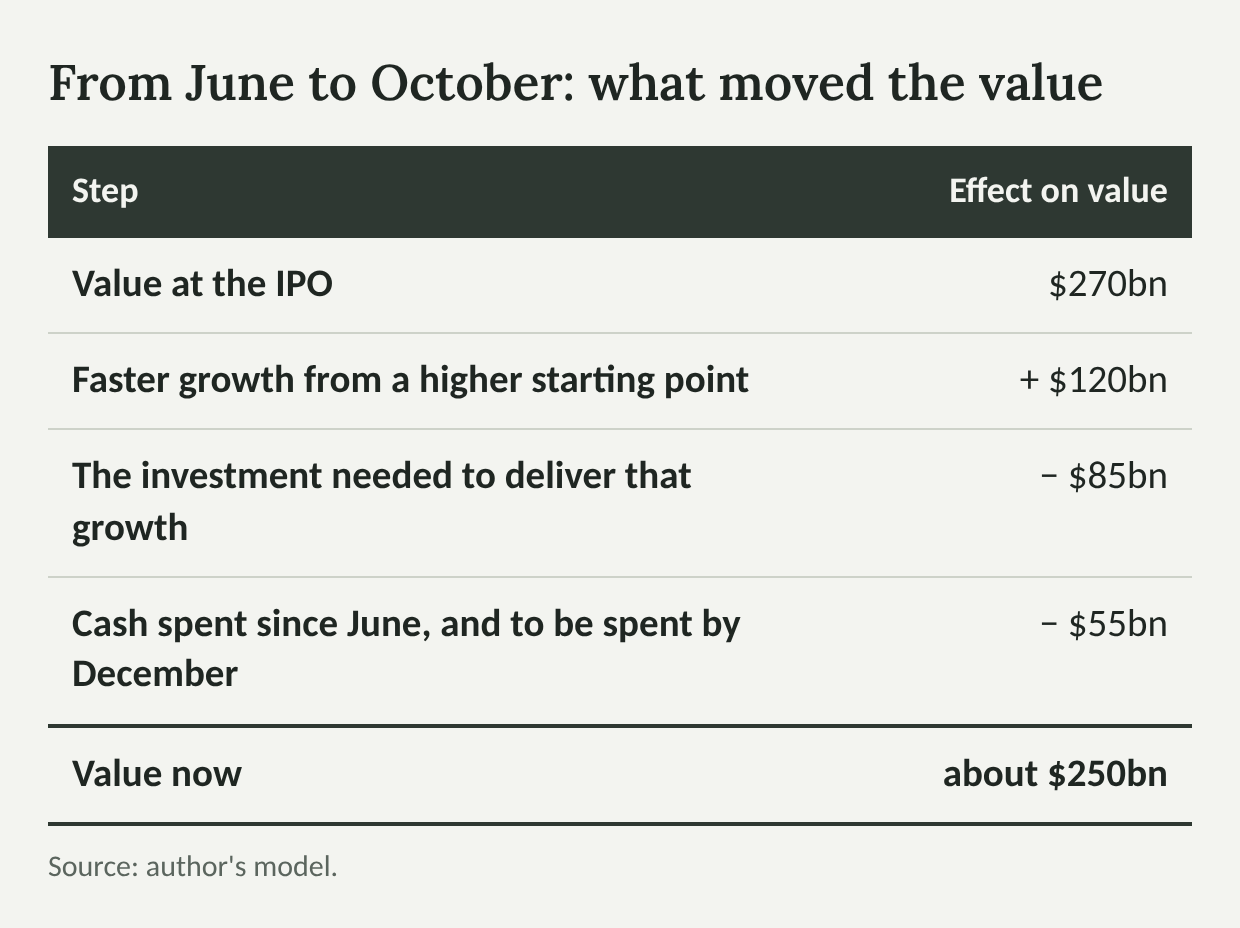
Between June and October the evidence improved and the valuation slipped. The share price nevertheless rose 27%. The widening gap cannot be explained by the performance of the business.
On today’s assumptions the next ten years of free cash flow are worth less than nothing. Investment outruns profit until 2031, and SpaceX needs about $200bn of outside funding to get there. The cash flows to 2036 subtract from value. More than all of today’s market value therefore has to be earned after 2036.
The dollar that decides it
My base case is now well below the market’s forecasts. Analysts expect revenue of about $102bn next year, and the consensus for 2030 is $372bn. My model has $70bn and $260bn. So I ran the consensus numbers through it.
The result depends almost entirely on one figure: how many dollars SpaceX must invest to win each extra dollar of revenue.
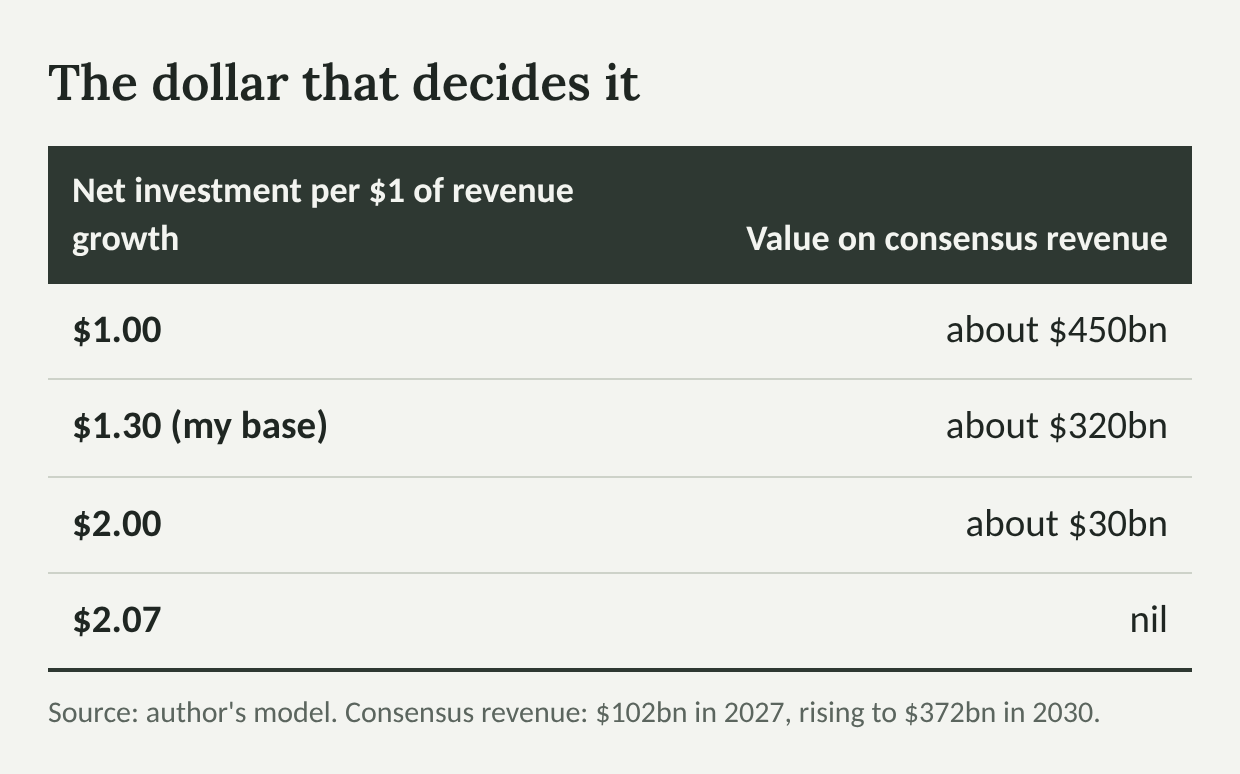
The reason is simple arithmetic. At a 30% margin taxed at 23%, a dollar of permanent revenue earns 23 cents a year. Capitalised at 13.2%, that is worth about $1.75 once the revenue is earning its mature margin, and less than that today. Spend less than that to win it and growth creates value. Spend more and growth destroys it, however fast the revenue line rises. The table reaches nil a little higher, at $2.07, because the cash and the existing business still have value to lose.
So what does SpaceX spend? There are two answers, and they are far apart.
Over the last twelve months it spent about $42bn on capital investment. Depreciation, on my estimate, was about $9.5bn, leaving net investment of about $33bn. Its annualised revenue rose by about $15bn. That is roughly $2.20 of net investment for each dollar. At that rate growth destroys value. Mechanically, the model produces a negative equity value on consensus revenue.
Management says its new compute pays back in less than a year. That implies about $1.
Both can be true for a while. Data centres are built before the contracts that fill them begin, so the trailing figure overstates the cost. But chips wear out and are replaced, satellites deorbit, and Starship earns nothing yet, so the payback claim understates it. The whole valuation turns on where between $1 and $2.20 the truth settles. Nobody outside the company can yet know.
What $2.3 trillion assumes
Again, no single driver closes the gap.
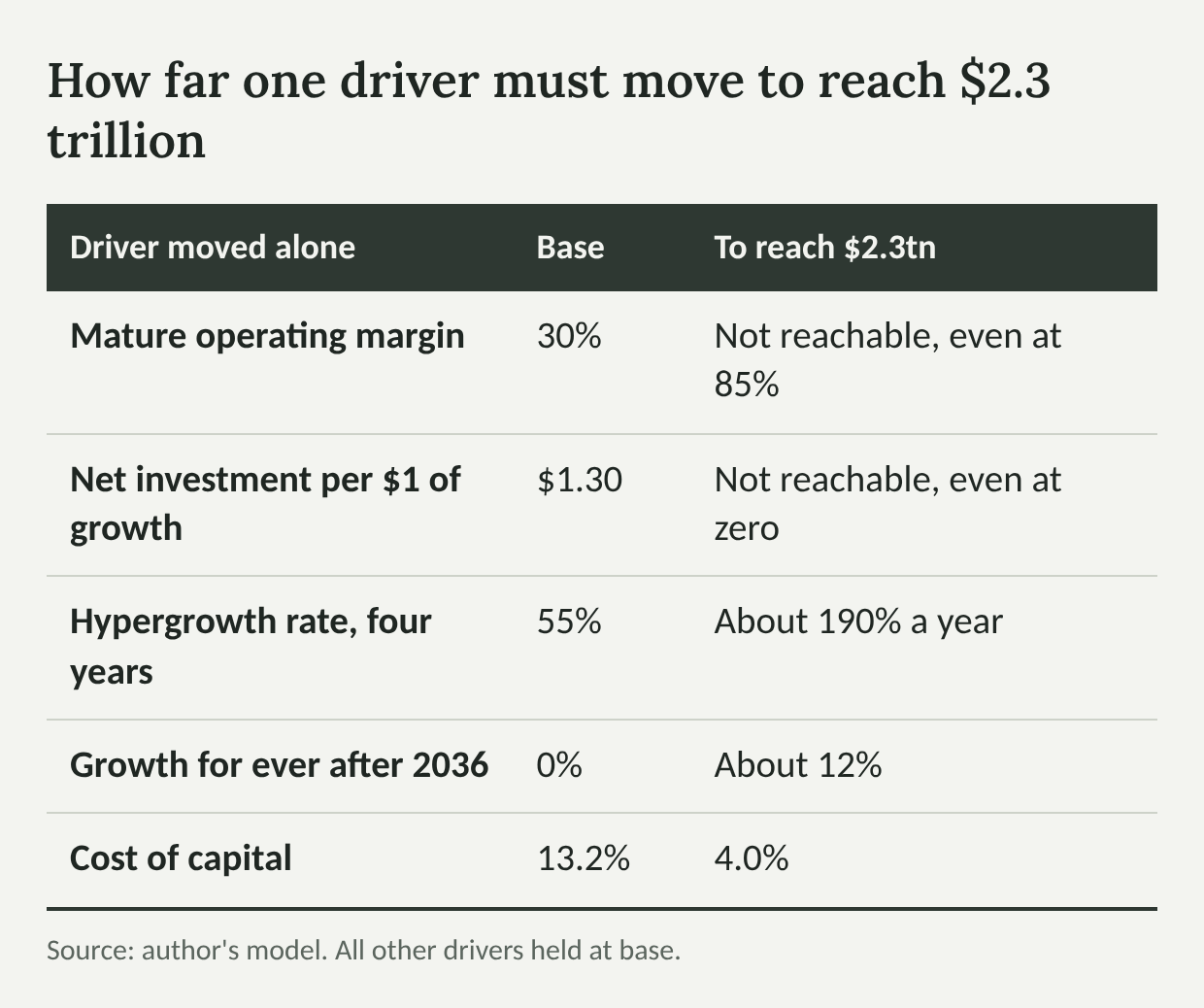
So I looked for a combination, and found one that needs no invention. It is management’s own plan.
Suppose SpaceX reaches $1 trillion of revenue in 2030, as it now says it will, and then grows at 15% a year for six more years. On my base margin and cost of capital, that is worth about $760bn. Raise the mature margin to 40%, above Starlink’s today, and it is worth about $1.5 trillion. Lower the cost of capital to 11% as well, and it is worth about $2.3 trillion.
That is what the price assumes. The trillion-dollar target is met on time. The whole group earns more than its best business earns now. And investors treat the result as a good deal less risky than its suppliers and peers.
It implies revenue of about $2.3 trillion by 2036, roughly three times Amazon’s sales last year. No company has ever earned $1 trillion in a year. SpaceX would need to do it within four years, from a base of $45bn.
It also has to be paid for. Even at $1.30 of investment per dollar of growth, that path consumes close to $1 trillion of cash between 2027 and 2030 before the business funds itself. At $2 per dollar, on my base margin and cost of capital, the same path is worth nothing.
Where the valuation is vulnerable
Capital. Everything SpaceX does needs continuing investment: AI compute, a Starlink constellation that must be replaced as it ages, and Starship. Before the results, the Visible Alpha consensus had capital spending rising to $118bn by 2028 and debt growing from about $42bn to more than $218bn. Forecasts have risen since: JPMorgan now sees spending near $200bn in each of the next two years. On 6 October the Financial Times reported that SpaceX is seeking a further $40bn of debt to buy Nvidia chips. That would roughly double its borrowings, to about $80bn. The IPO bought time, not self-sufficiency.
Concentration. The fastest-growing part of SpaceX is renting compute to rivals, and four contracts carry it. Anthropic’s runs to May 2029, but after an initial three months either side can end it on 90 days’ notice. Google’s can be ended the same way from January. SpaceX itself counts only $14.1bn of these agreements as firmly contracted. Starlink, meanwhile, is growing on volume: revenue per subscriber is $66 a month against $85 a year ago, though it held steady last quarter. And Starship remains a cost until it flies commercially.
Control, and who carries the risk. Mr Musk decides how much to spend, and on what. The merger with xAI at $250bn and the purchase of Cursor for $60bn in new shares were capital allocation decisions that minority shareholders now carry. Those shareholders are changing. SpaceX joined the Nasdaq-100 on 7 July, so index funds already own it. The first lock-up expiry released more than 900 million shares in August. Smaller releases have followed every fortnight or so since, and the largest, of up to 1.3 billion shares, comes after the third-quarter results in early November. Risk is passing in stages from concentrated private holders into the wider public market.
What the model cannot see
A cash flow model cannot value what has not yet been built. Starship at full reuse, data centres in orbit, a mobile network from space: none appears in my forecasts, except as cost. The market is plainly paying for them. In the language of finance, much of the price is an option on businesses that do not yet exist, and options can be rational. Amazon’s early shareholders were buying options too.
The question is one of proportion. On my assumptions, about $2.1 trillion of the market value is unexplained by the businesses and cash flows I can model today. Some of that may be better economics in the existing businesses than I allow. The rest is the option.
How large that option should be is precisely what a cash flow model cannot tell us.
The valuations are not independent. In my Anthropic piece I argued that the frontier labs, their suppliers and their investors validate each other’s numbers. SpaceX makes this concrete. Anthropic’s rent is the largest single part of SpaceX’s AI revenue. Anthropic’s ability to keep paying depends on raising money, including through its own IPO. And the success of that IPO depends in part on the market’s appetite for AI listings, which SpaceX’s share price helps to set. Revenue recognised in one part of the ecosystem depends on capital raised in another.
Three things will tell us most, starting with the third-quarter results in early November.
1. Whether investment per dollar of new revenue falls towards $1 or stays above $2.
2. Whether the compute customers broaden beyond four, and commit for longer than 90 days.
3. Whether December’s revenue reaches the $100bn annual rate. It is the first staging post on the road to $1 trillion.
The market may be right. Starship may transform the cost of reaching orbit, and today’s spending may look cheap in retrospect.
But Anthropic asked whether today’s business can keep tomorrow’s economics. SpaceX asks something harder: whether tomorrow’s businesses can justify today’s price. At $2.3 trillion a shareholder is no longer paying for the company SpaceX is. The question is how much of the future you are willing to pay for before it arrives.
The figures in this piece come from SpaceX’s prospectus and second-quarter results, press reports of both, and market data on 6 October 2026. The model is my own, built with the help of Claude, Anthropic’s AI model. Anthropic is a SpaceX customer and is discussed in this piece; readers should know that. Nothing here is investment advice.
Notes on the model
• Margin path. The operating margin starts from about minus 14%, the 2025 level, and rises in equal steps to reach the mature margin in 2031. Working capital investment is set to zero.
• 2026 revenue. $45bn is my estimate: $12.5bn in the first half, plus a second half lifted by the compute contracts.
• Net cash. $100bn of cash and securities less $39bn of debt and finance leases at 30 June, less about $30bn of estimated net spending in the second half.
• Consensus case. Revenue of $102bn in 2027, $160bn in 2028, $232bn in 2029 and $372bn in 2030, then 15% a year for six years.
• Management case. Revenue of $150bn, $300bn, $550bn and $1 trillion in 2027 to 2030, then 15% a year for six years. The route to $1 trillion is my interpolation; management has given only the destination.
• Investment over twelve months. Capital spending of $20.7bn in 2025, less $7.0bn in the first half of 2025, plus $28.5bn in the first half of 2026. Revenue growth is the second quarter annualised, against the same quarter a year earlier. Depreciation of about $9.5bn is my estimate: $5.3bn reported for the first half of 2026, plus about $4.2bn for the second half of 2025, inferred from the 2025 operating loss and adjusted EBITDA.
Sources
• SpaceX prospectus, Form S-1, SEC
• SpaceX second-quarter 2026 results, SEC, 4 August 2026
• SpaceX quarterly report, Form 10-Q, SEC
• SpaceX revenue surges 92% to $7.8 billion, Fortune, 4 August 2026
• Elon Musk repeatedly one-upped his execs on SpaceX’s first earnings call, TechCrunch, 4 August 2026
• How long is Anthropic’s lease with SpaceX? Opinions vary, TechCrunch, 28 May 2026
• SpaceX CFO: new compute deal puts company closer to $100bn ARR goal, The Motley Fool, 17 September 2026
• SpaceX seeks $40 billion financing to buy Nvidia chips, sources say, Reuters, 7 October 2026
• SpaceX earnings preview, Q2 2026, S&P Global Visible Alpha
• SpaceX market cap history, StockAnalysis
Richard Anderson
Founder, AndersonRisk
This essay was first published on 9 October 2026 on my Substack.