
The money that comes home
In 2000, Lucent and Nortel were lending their customers the money to buy their equipment. Telecoms start-ups borrowed from the kit makers, bought the kit, and the kit makers booked the sales. For a while it looked like demand. When the start-ups failed, the loans went bad, and some of the sales turned out to have been the suppliers’ own money coming home.
Something with a family resemblance now runs through artificial intelligence, and it is no longer only commentators who have noticed. In June, the Bank for International Settlements named AI as one of four pressure points for the global economy and singled out what it called circular financing. In August, Andrew Bailey, writing as chair of the Financial Stability Board, warned the G20 that cross-investment between AI companies and hyperscalers, combined with leverage, high valuations and concentration, could amplify a future market correction. In September, the Bank of England’s Financial Policy Committee pointed to rising indebtedness, limited transparency and, at times, “circular arrangements” in AI financing. Paul Krugman has come at it from another angle, asking what the rest of the economy goes without while capital pours into AI.
Most of this has been written for regulators and investors. My question is different. What does circularity mean for an ordinary company that uses AI, and what should its directors be doing about it?
The circle
The circle has three points: the chipmakers, led by Nvidia; the hyperscale cloud providers; and the AI firms that build and sell models. Each finances the others and buys from them. A chipmaker takes an equity stake in an AI lab or a smaller cloud provider, and the lab commits to buy chips or computing power, often for years. A cloud provider invests in the lab that rents its capacity. Money goes out as investment and comes back as revenue.
The BIS has now begun to measure it. In a bulletin published on 1 October, its researchers found that 55.2% of the investment value flowing into AI firms between 2021 and 2025 came from other AI firms. Of the value of those AI-to-AI deals, 46.4% also involved a supply relationship between investor and investee. That does not prove the revenue is artificial. It does show how often the investor and the customer are the same company. Nvidia, meanwhile, has set up financing platforms with six of the world’s largest asset managers, intended to mobilise more than $500 billion of third-party capital for its customers over time, while keeping some of the risk itself: it can backstop up to a quarter of the deals.
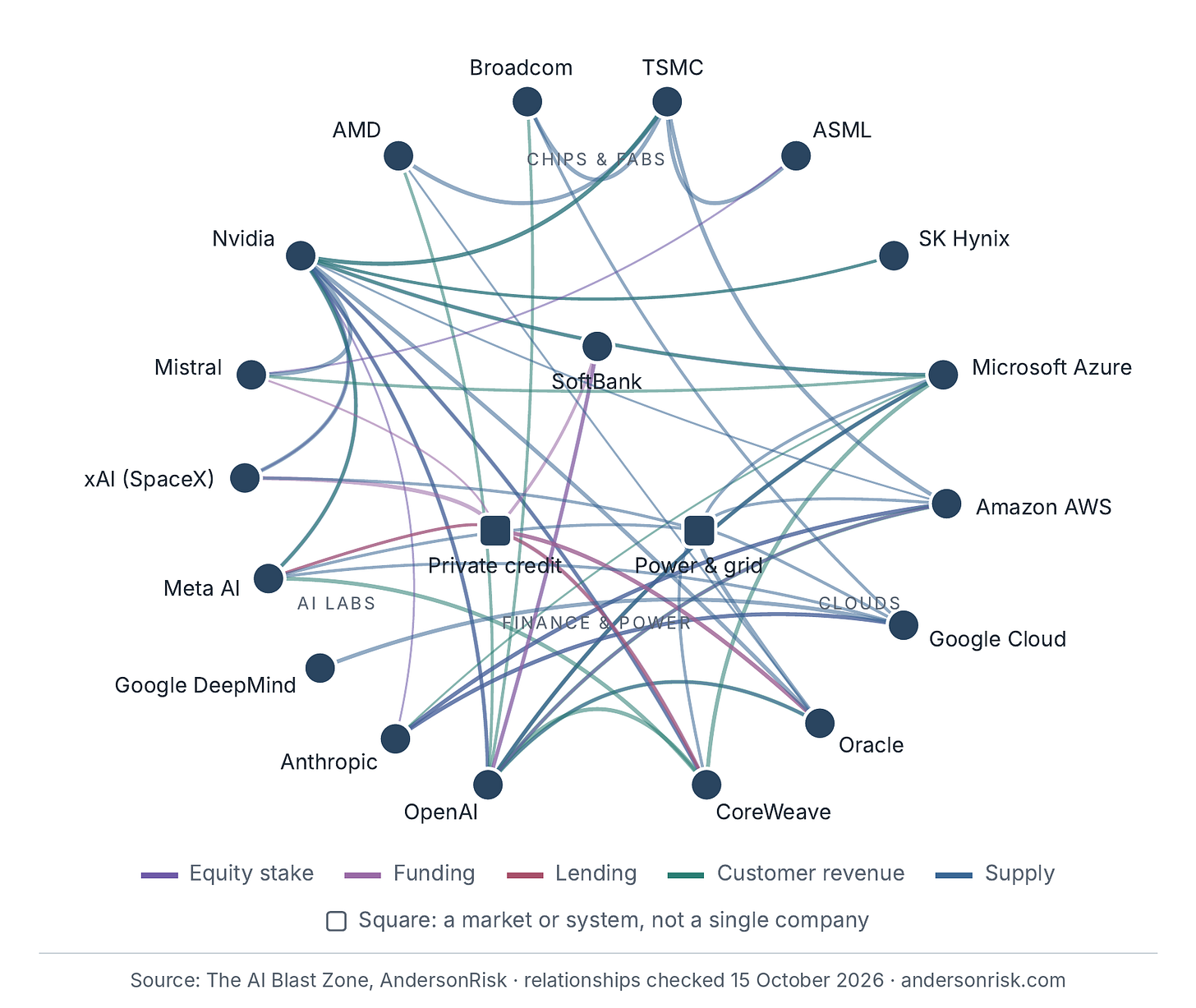
Financing and supply links between leading AI firms, as checked on 15 October 2026. The live, updated version is in the AI Blast Zone.
There is a fair defence. Advanced chips and data-centre capacity are scarce and very expensive. Pairing finance with long-term purchase commitments lets suppliers, builders and customers move faster than conventional fundraising would allow. Car makers have financed their customers for a century, and few people call that fraud. Nor is this round-tripping, where two firms swap invoices to inflate revenue without any economic substance. Most of these deals are public, and the chips and the compute are real.
So the question is not whether circular financing is wrong. It is what you need to believe for it to be safe, and what happens to firms outside the circle if those beliefs turn out to be wrong.
What the circle does
Circularity does three things, each more serious than the last.
It makes demand harder to read. Financing a customer is not wrong in itself, and the chips and compute being bought are real. The difficulty is that when investment is tied to purchase commitments, revenue that looks like independent demand is partly the supplier’s own capital. Each party’s growth depends on the others continuing to invest. Investors, lenders and customers reading the figures cannot easily tell how much reflects businesses and consumers paying for AI because it is worth it, and how much is capital going round.
It makes substitution look easier than it is. A board told that its AI supplier risk is managed because it has a second provider should ask two questions about that second provider. Who funds it? And what does it run on? These are two different maps. Two providers may share investors without sharing any infrastructure. A provider may be financially independent but run entirely on Nvidia chips and CUDA software, on a single cloud platform, or on another firm’s foundation model. A fallback supplier can be independent on one map and captive on the other. You are only as independent as your ability to switch, and that depends on both.
It widens the blast zone. The BIS notes that the terms of these deals are often poorly disclosed, with the risk of the same asset being pledged more than once, and that more of the money now sits with private credit funds and other lenders that face less oversight than banks. A BIS working paper in July went further, modelling how firms racing for a few dominant positions overinvest, and how stress in one firm could cascade to others through chains of circular financial exposure. Stress in one corner of the circle travels round it instead of being absorbed.
Lloyd’s of London has seen this before. In the 1980s, syndicates writing London market excess of loss reinsurance passed catastrophe risk to one another, round and round the market, rather than laying it off elsewhere. Each believed it had capped its exposure. When Piper Alpha burned in 1988, a loss to Lloyd’s of about $1 billion generated around $16 billion of claims as the policies triggered one another, and some syndicates found they had insured the same rig many times over. The premium flowing round the spiral had looked like a thriving business. It was the same risk, counted again and again, and when it came home, Names with unlimited liability lost their homes.
The secondary banking crisis of 1973–75 adds a different lesson, about funding. The fringe banks borrowed short in the money markets and lent long against property. When interest rates rose and property fell, their funding disappeared, and the Bank of England organised the clearing banks into a lifeboat that at its peak lent about £1.3 billion, roughly 1% of GDP. The AI version is a mismatch the other way round. The problem is not short money funding long-lived assets, but long debt funding assets that wear out or are overtaken within a few years. If the chips lose their economic value before the debt is repaid, the income they generate may no longer cover the financing costs. Refinancing becomes harder as collateral values fall, and lenders who were relaxed in the boom become cautious all at once.
Lloyd’s was risk that never really left the system. The secondary banks were funding that could not survive a change in conditions. The AI circle has room for both.
From financial stress to an AI winter
This is where the regulators stop: a correction, losses, tighter credit. A sceptical director might reasonably say that a fall in AI valuations need not touch their business at all. The chips already installed keep working. Distressed data centres would be bought by stronger owners, and capacity might even become cheaper.
That may be true for a while. But there are several routes from financial distress to operational disruption:
New investment stops, and the next generation of chips, data centres and models is delayed or cancelled.
Intermediate providers, the smaller clouds and model resellers that many firms actually buy from, fail or are absorbed.
Surviving capacity concentrates in fewer hands, with the pricing power that brings.
Prices held down by investors’ money rise to cover their real cost.
Support ends for models already built into business processes. Providers retire model versions in normal times; under financial pressure they would do so faster and with less notice.
Taken together, that is what I mean by an AI winter. Not that AI disappears, but that the capabilities firms have come to depend on stop being available on the terms, at the quality or with the continuity they assumed, and stay that way for years rather than quarters. Because the three points of the circle fund each other, all three could be depleted together: advanced chip supply, cloud capacity and AI development. There have been AI winters before, in the 1970s and late 1980s, when funding and interest collapsed after the promises outran the results. The difference is that firms then were experimenting with AI. Now many of them run on it.
That is a scenario, not a prediction. But boards should know what their plans assume about it.
How it reaches your firm
A company nowhere near Silicon Valley is exposed in at least four ways.
As a customer. This is the route most boards will recognise, and the one they are most likely to underestimate. The obvious risk is one provider failing. The larger one is the winter described above: capacity scarce, rationed or dearer across the whole market at once, models withdrawn or changed, and no outside supplier to turn to. Contracts negotiated in a buyer’s market may be renegotiated in a seller’s one.
As a borrower, and as a buyer of everything else. In June I asked on LinkedIn whether the AI mega-IPOs would draw oxygen from other companies seeking finance. On 6 October, Paul Krugman argued that in the United States this is already happening: data-centre spending is pushing up long-term interest rates and crowding out other investment, unlike the 1990s tech boom, when foreign capital financed the expansion. He also points to two other channels: data centres absorbing scarce electricity, and a surge in memory-chip prices hurting industries from cars to personal computers. The UK picture is less clear. The Bank of England said in July that there was as yet little evidence of AI crowding other borrowers out of funding markets. So for a British board, crowding out is a live question rather than a settled fact. The greater risk may come after a correction, when lenders and funds heavily exposed to AI pull back together, and firms outside the sector find credit dearer and harder to get through no fault of their own.
As an investor. Through pension schemes, treasury holdings and index funds, many companies and their employees already own a share of the circle without having chosen to. The concentration of market indices in a handful of AI-linked firms means a correction there is not someone else’s problem.
As a lender or insurer. For financial services boards, the exposure may be direct: loans to data-centre projects, private credit allocations, cover written for infrastructure whose value depends on the circle holding together.
What directors should ask
None of this means a board should stop using AI. It means knowing where the exits are, and whether they lead anywhere. The questions are simple to ask and often hard to answer:
If AI capability became scarce and expensive for three years, which of our processes would still work? What have we already dismantled, including people and skills, that we could not quickly rebuild?
Do we know who funds our critical AI suppliers, one level down?
Does our fallback supplier depend on the same financiers, infrastructure or models as our main provider?
What happens if our AI costs double, or a provider stops serving us at short notice?
Do our contracts and exit plans assume the supplier will survive?
Who on the executive team owns this question, and has the board ever discussed it?
The first question matters most. Most resilience planning assumes that if one supplier fails, another will take its place. Circularity weakens that assumption, and an AI winter would remove it. The test is not whether you could switch provider but whether you could operate, in a reduced form, without the circle at all.
Behind all of these sits a broader question: what assumptions about the continued financing of the AI ecosystem are built into our own business model? Plans, budgets and operating models tend to extrapolate from today’s relationships and prices, as if they will survive the journey. It is the straight line again, and the circle is one of the places where it could bend.
In the end this is a question of risk appetite. Most boards have some statement of appetite for operational disruption, supplier concentration or strategic dependency. Fewer have asked whether the operating model management is building is consistent with it. The issue is not simply whether the company has an exit plan. It is whether the board has knowingly accepted a level of dependence that could leave the company unable to deliver critical services under severe stress, or has drifted into it one sensible procurement decision at a time. And it is whether the board and the executive share a common view of how much the business now relies on something it does not control and cannot easily see.
The lifeboat question
In 1974 there was a lifeboat because there was someone with the standing to launch it. The Bank of England could call the clearing banks into a room and tell them what was needed. If the AI circle came under strain, it would span American hyperscalers, a global chipmaker, private credit funds in several jurisdictions and AI labs whose value rests on expectations. It is not obvious who would call that meeting, or whether anyone would come.
For a board, the practical conclusion is uncomfortable but simple. Your exit route may run through the same circle you are trying to leave. Find out before you need it.
Richard Anderson
Founder, AndersonRisk
This essay was first published on 22 October 2026 on my Substack.