
Wayve, the British self-driving company, raised money in February at $8.6 billion. I ran the same reverse valuation I used on Anthropic and SpaceX. For the first time in this series, the answer is a number I can picture. It suggests that AI can be built in bite-sized chunks, for small beer beside the sums the frontier consumes. What I cannot model is whether people will let go of the wheel.
A note before we start. Wayve is a private company. Its last filed accounts cover the year to August 2024, when it had no material revenue. Accounts for the sixteen months to December 2025 had not appeared at Companies House when I checked on 10 October. So this piece rests on far less data than the other two, and several inputs are my own estimates. I say which.
My last two pieces asked what you would have to believe to buy Anthropic at $2 trillion and SpaceX at $2.3 trillion. Both were about scale: the largest models, the largest data centres and the largest listings in history.
Wayve is the counterpoint. It builds one kind of AI model for one purpose: driving a car. Its price is less than half of one per cent of either of theirs. And it is a long way from a stock market. The price was set in a private round by professional investors, most of whom are also its suppliers or its customers.
That changes the exercise. With Anthropic and SpaceX I asked whether a price could be justified at all. Here the price can at least be explained. That is not the same as saying it is right, and I will come to the difference.
The explanation matters more than the price. There is a growing anxiety in Britain, and in every country that is not the United States or China, that the AI revolution has been missed because nobody here has built an OpenAI or an Anthropic. That assumes AI is one thing, made at one scale.
Wayve suggests it can also be made in bite-sized chunks: one job at a time, for a fraction of what the frontier consumes. I should declare an interest. It is close to what I argued in the Straight Line essays, so I am inclined to believe it. The valuation is how I test it.
What we know
There is no prospectus. This is what the public record shows.
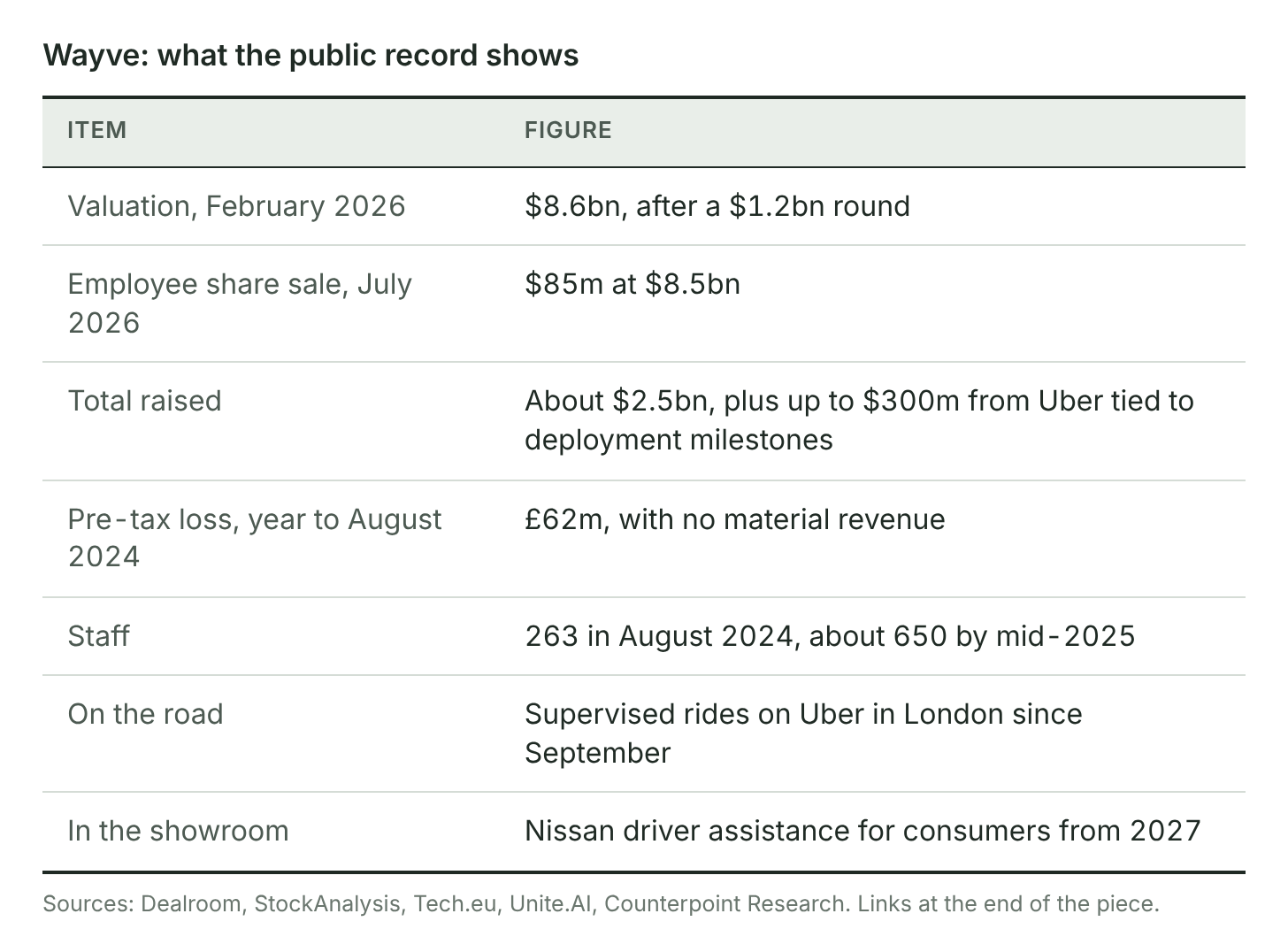
Alex Kendall, Wayve’s co-founder and chief executive, gave some further figures to Robert Peston on The Rest Is Money. He said Wayve has raised $2.8bn, which I take to include Uber’s conditional $300m, and does not need more to launch its first products. I use several of his figures below and mark them as his.
Two things stand out. There is no revenue line to extrapolate. And the sums are small by the standards of this series.
How I approached it
The model is the same: Dr Andrew Black’s seven drivers, with a residual that assumes no growth once the value growth duration ends. I kept the conventions of the Anthropic piece. The cost of capital is 13.7%, the figure I used for an unlisted company in that ecosystem. The mature operating margin is 30%. Tax is nil for five years while losses are used up, then 23%.
One thing is different. With Anthropic and SpaceX I could start from reported revenue and build a base case. Wayve has no revenue to start from. So I have only run the model backwards: fix the price, set the other six drivers, and solve for the revenue.
Revenue follows an S-curve from nothing in 2026 to a target level in 2036. Three inputs are my own estimates, because nothing is disclosed. Net cash is $1.5bn at the end of this year. Costs run ahead of revenue by about $450m a year at first, tapering to nil by 2032. And each dollar of new revenue needs 15 cents of investment. These are inputs to a model, not evidence about the business.
What the price requires
On those assumptions, $8.6bn requires revenue of about $8.8bn in 2036. That is roughly a dollar of revenue, ten years out, for each dollar of today’s price.
It is not a precise figure. The inputs are far too uncertain for that, and one of them matters more than the rest.
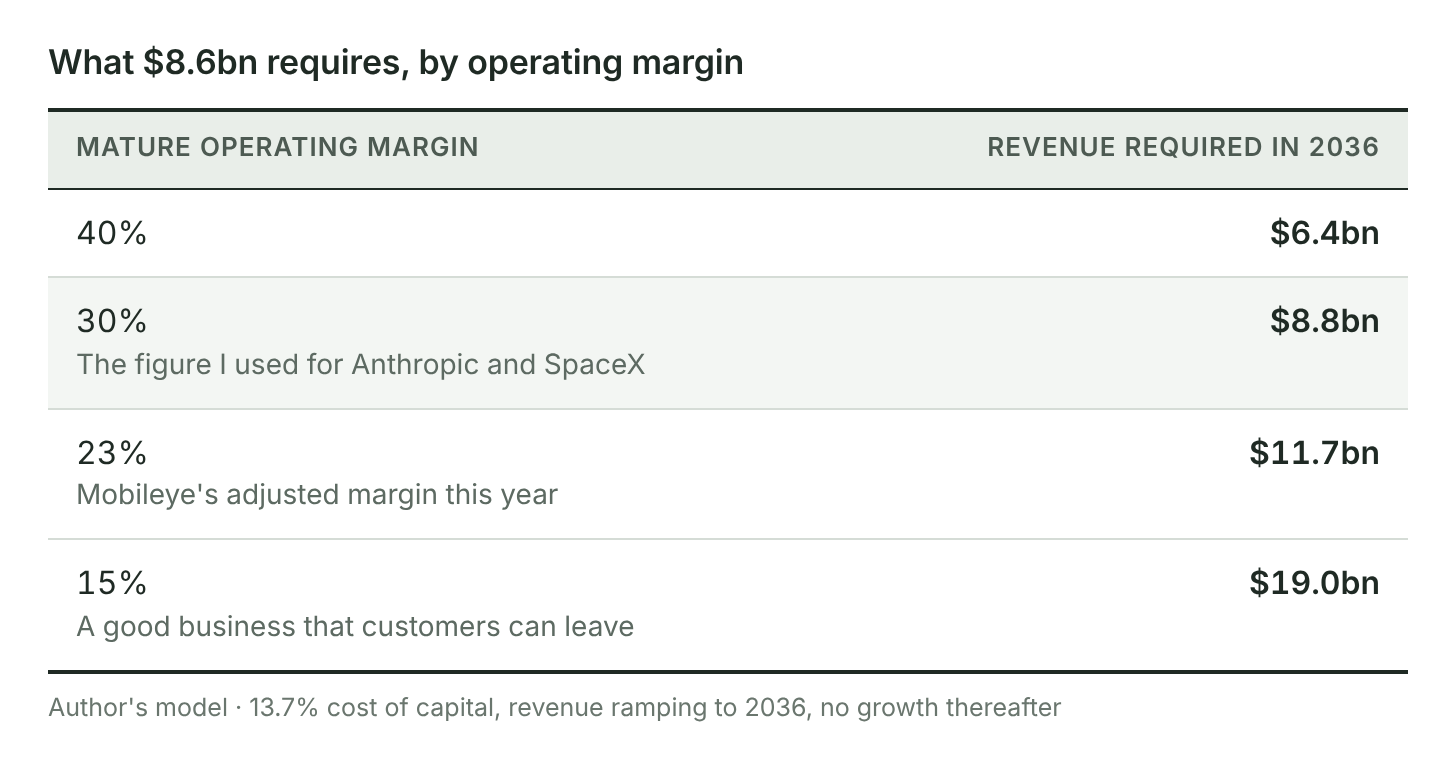
I kept 30% so that the three pieces can be compared. For Wayve it may be generous. Mobileye, the closest listed comparison, sells driver-assistance technology to carmakers and earned an adjusted margin of 23% in the first half of this year. That is the flattering measure. On a reported basis, Mobileye made an operating loss.
In the Anthropic piece I said that customers who can replace a supplier do not pay it rent, and I used 15% for a business that customers can leave. Wayve’s customers can leave. Its pitch is that the software goes on any car, and the carmakers test it against rivals.
So the model gives a range, not an answer: from about $9bn to about $19bn, depending on the margin. The specialised, replaceable AI I have argued for is good for the customer. It is harder on the supplier’s shareholders.
Is that a lot? At the bottom of the range it is between four and five times Mobileye’s 2025 revenue, which took a quarter of a century to build. Wayve would need about $2.7bn by 2030 and $6.1bn by 2032 to be on the path.
But it is a number I can test against something that exists. Mr Kendall says Tesla earns about $1.5bn a year from just over a million subscribers to its self-driving software. That is about $1,500 a car a year. If Wayve kept a third, with the carmaker keeping the rest, $8.8bn would need about 18 million cars paying a subscription.
If carmakers instead paid Wayve a fee of $500 for each car they built, it would need about 17.5 million new cars a year. That is roughly one in five of the cars built worldwide.
I do not know which of those models applies. Wayve says it licenses its software to carmakers, and the terms are not public. It matters, because a car fitted with the system, a car using it and a car paying for it are three different things.
The cash holds up, on one condition. On my estimates free cash flow is negative until 2029, the cumulative outflow peaks at about $0.8bn that year, and the money is earned back during 2031. That is inside what Wayve says it has. But it assumes revenue arrives on the ramp the price requires. A slower ramp needs more capital.
Compare the other two. No single driver could carry Anthropic to $2 trillion on terms I recognised. SpaceX needed $1 trillion of revenue by 2030, which no company has ever earned in a year. Wayve needs to become several times the size of Mobileye in ten years, at margins Mobileye does not yet earn.
That is demanding, and more than half the value still lies after 2036. I am not saying Wayve is reasonably valued. I am saying its price can be explained, in terms a carmaker’s board could check against its own production plan.
Who set the price
In the Anthropic piece I recalled Andrew Black’s verdict on the dot-com boom: the economics of shareholder value had held, and the market had been engaged in a willing suspension of disbelief. I said I recognised the symptom. I see less of it here.
The February round was led by Eclipse, Balderton and SoftBank’s Vision Fund 2. Nvidia, Microsoft and Uber took part. So did Mercedes-Benz, Nissan and Stellantis, the first carmakers to invest directly.
These are not buyers taking a story on trust. The carmakers have driven the product, and Mr Kendall says they have benchmarked it against Tesla’s system and the leading Chinese ones. I have only his word for the results, but the tests are theirs to run.
Some of the money is conditional: Uber’s further $300m is paid against deployment milestones. And the price has not run away. In July, staff sold $85m of shares at $8.5bn, a shade below February’s figure. Anthropic’s IPO target is about twice the price it set in May.
I should not overstate this. Professional is not the same as disinterested. Nvidia sells Wayve chips, Microsoft sells it cloud computing, and the carmakers need an answer to Tesla. And Anthropic’s $965bn was set by professionals too. The difference is not who the investors are. It is what they were asked to believe, and whether they could check it.
There is a second difference. In the Anthropic piece I asked who inherits the line. Here nobody does. There is no index fund obliged to buy and no pension member holding Wayve without having decided to. Everyone on the register chose to be there.
Where the model runs
The first two pieces were, at bottom, about compute. Anthropic has $518bn of future obligations for it. SpaceX spent $15.8bn on it in a single quarter. In both cases, serving the next customer means buying or renting more.
Wayve separates two things that the frontier companies keep together: teaching the model and using it.
The teaching happens in data centres. Mr Kendall says the model improves with more data and more compute, and Wayve trains on Microsoft’s cloud using Nvidia’s chips. That is not cheap, and I cannot see the bill, because the accounts are two years old.
The using happens in the car. He describes hardware costing hundreds of dollars: a small computer, cameras and radar, fitted to something as modest as an electric Fiat 500. He contrasts that with the server chips costing tens of thousands of dollars that a language model needs. The carmaker fits the computer and the buyer pays for it. When Wayve wins another million cars, it does not need another data centre to serve them.
In the seven-driver model this shows up in one place: the investment needed to win each new dollar of revenue. I assumed 55 cents for Anthropic and $1.30 for SpaceX. For Wayve I have assumed 15 cents. That is my judgement, not a disclosed figure. The cost of retraining and safety testing sits in the margin, which is one more reason to doubt 30%.
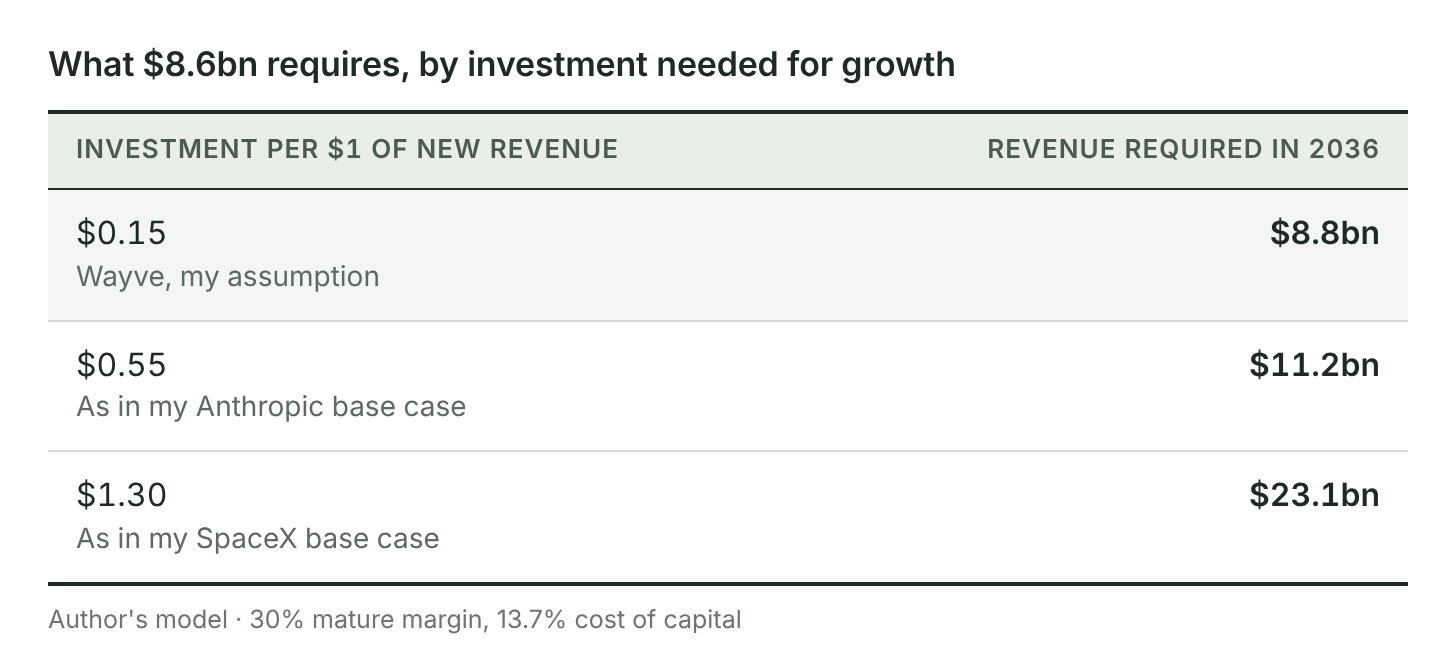
At SpaceX’s rate, the same price would need more than two and a half times the revenue, and several times the capital Wayve has raised.
Bite-sized chunks
None of this makes Wayve small. It has raised about $2.5bn, and it depends on two of the largest technology companies in the world. But the sums are of a different order. Everything Wayve has raised in ten years is less than two weeks of SpaceX’s capital spending last quarter. Waymo, its best-funded rival, raised $16bn in a single round.
It was built that way out of necessity. Mr Kendall started ten years ago with $1.5m, by his account, when rivals had billions. Several of those rivals have since closed. He says scarcity forced a more efficient design.
The efficiency is not only in the car. Mr Kendall says Wayve began with far less data and computing power than Tesla or Waymo, and had to learn more from each mile. It replays a real situation many times in simulation, varying what the other road users do, much as a tennis player rehearses a shot in the mind. These are his claims, and no outsider has measured them. But they describe a company that found a different way to solve the problem because it could not afford the usual one.
What made it possible was scope. Wayve set out to do one job. A job with edges can be measured, tested against rivals and paid for by the people who benefit from it.
The price reflects that. On my arithmetic, driving alone can account for $8.6bn. Mr Kendall talks about taking the model into manufacturing and robotics, and Wayve launched a labs division this year to try. That is where the company may go next. I do not think it is in this price. With SpaceX I could not explain about $2.1 trillion of the value without businesses that do not yet exist. Here I do not need them to explain the price. Whether Wayve can earn the revenue is a separate question.
I should be careful about what this shows. Wayve is not a different kind of AI. It is one large learned model, built from the same science as the language models, and its founder expects the two to converge. It aims to work across cars, cities and countries. So it is not evidence that the frontier approach is wrong.
It is evidence of something more useful. I have described intelligence as specialist by default and generalist by exception. Wayve shows that a serious AI business can be built one chunk at a time: a bounded job, and a model small enough to run on a cheap computer where the work is done.
Who is driving
A chunk of AI is only worth something if people will hand the job over. That is the test every deployment has to pass, and it is where a spreadsheet stops.
Mr Kendall draws a line that I think is fair. There is a debate to be had about frontier AI, he says, and a different one about AI deployed in a single sector. In driving, the risk is understood. Insurers can price it. Regulators already exist. The system can only drive.
It is the best argument I have heard for AI with a bounded job. But the risks are wider than the ones you can see through the windscreen.
John Adams distinguishes three kinds of risk: those we perceive directly, those we perceive through science, and virtual risks where knowledge runs out. Road safety is his home ground. A driver manages a directly perceived risk by instinct, and feels in control of it.
Wayve asks that driver to make an exchange. Give up a risk you manage yourself, and accept in its place a risk you know only as a statistic. The statistic may become overwhelming. It may become close to certain that the car is safer than you are. The exchange is still not a calculation.
Mr Peston put it well at the end of the interview. However good the data, he said, the first death will bring a moral panic, because people do not feel risk the way the numbers describe it.
Part of the difficulty is borrowed certainty. Insurers can price human driving because they have a century of claims. They have almost no history for a machine driver. The confidence belongs to the old risk, and it is being lent to the new one.
Part of it is the shape of the risk. Human errors are largely separate. Bad weather or a badly designed junction can catch many drivers at once, but one driver’s lapse tells you little about the next car. A model’s error is shared by every car that runs it. Safer on average and safe to rely on are different claims.
That cuts both ways. A fault found in a model can be corrected in every car at once, which no amount of training achieves with human drivers. So the risk is not simply larger. It is concentrated, for better and for worse. Any organisation that runs its decisions through one common model has the same property.
And part of it is who answers for the outcome. Under the Automated Vehicles Act, when an authorised vehicle is driving itself, responsibility for how it drives no longer rests with the person in the seat. It rests with an authorised self-driving entity. Counterpoint reports that Wayve intends to take that role in London.
The service today is supervised, so that regime does not yet apply, and insurance and contracts will divide the cost in ways I cannot see. But the direction is clear. Decisions that millions of drivers used to answer for one by one will be answered for by a few organisations. My model has no line for that.
Then there is the stage we are in now. A person sits in the driving seat, watching a machine that is usually right. Adams has long argued that people who feel safer take less care. Supervision is the hardest job to give them.
All of this reaches the valuation, by more than one route. If Wayve is paid by subscription, the owners who choose to pay are the business. At three in ten, 18 million subscribers means fitting the system to about 59 million cars. At three in twenty, it means about 118 million.
If carmakers pay a fee for each car, the driver never makes that choice. The carmaker makes it for them, and carries the risk that buyers do not value what has been fitted. Either way, somebody has to decide that a machine can be trusted with the job.
I have written that risk appetite is revealed in behaviour, not in documents. Here it will be revealed one car at a time.
In the Anthropic piece I wrote that AI might become cheaper, smaller, more specialised and more useful. Wayve is already the first three. Whether it becomes the fourth depends on whether we will let it drive.
Where the price is vulnerable
The margin is the weakest assumption in the arithmetic. It is not the only one.
Wayve reaches drivers through carmakers and riders through Uber. That is a wide route to market, far wider than Tesla’s, which sells its software only to people who buy a Tesla. But somebody else owns the customer and sets the price. How much of the value it creates Wayve gets to keep is the question I would most like answered.
The competition is formidable. Waymo was valued at $126bn in its latest round. Tesla has the data from its own fleet. Chinese developers are deploying faster than anyone.
And the ramp needs permission. The London cars still carry a safety driver. Mr Kendall names the steps before that changes: vehicles built for the purpose, evidence of safety on those vehicles, and regulatory approval. He would not give a date. One very bad day could move it.
Every estimate of mine will need replacing when Wayve’s accounts appear.
What to watch
The evidence will come from Wayve itself.
The accounts to December 2025: the cost base, any revenue, and what it spends on training.
When the safety driver leaves the car in London, and on what evidence.
The first figures for how many cars carry the system, and how Wayve is paid for them.
For a board, the questions travel well beyond cars. Where are we asking staff or customers to rely on a machine’s judgement in place of their own? When the machine acts, who answers for what a person used to answer for? And which of our uses of AI really need the largest model, and which are a bounded job that something smaller could do?
No need to panic
Mr Peston’s worry, through much of the interview, was a familiar one: that Britain builds promising technology companies and then loses them. The AI version of that worry is sharper, and it is not only British. The frontier models are being built in the United States and China, at a cost few others could contemplate.
I think the worry mistakes one stage of AI for the whole of it. Wayve has raised about $2.5bn in ten years. Anthropic has committed $518bn to compute. If both prices are right, they are right about different futures.
Wayve does not show that the frontier models are a mistake, or that anyone can ignore them. It rents its training from Microsoft and buys its chips from Nvidia, and most of its capital has come from abroad. Dependence on a few suppliers is a real concern, and I have written about it before.
What Wayve shows is that useful, valuable AI can be built in bite-sized chunks. It was started with $1.5m, for a market its investors could inspect before they paid. It took serious money, but it was the money of a company, not of a country. It does not require winning a race that has already been priced in trillions.
If there is something to worry about, it is closer to home. Mr Kendall told Mr Peston that Wayve’s money has come mostly from abroad, including a Canadian teachers’ pension fund, and he called the state of UK growth and pension funding “abysmal”. Missing the frontier is one thing. Not backing what can be built without it is another.
The frontier is one way to build AI. Wayve is evidence that it is not the only one, and that the other way can be had for small beer.
The figures in this piece come from press reports, Companies House and an interview Alex Kendall gave to Robert Peston on The Rest Is Money. Wayve has not published recent accounts, and several inputs are my own estimates. The model is my own, built with the help of Claude, Anthropic’s AI model. Nothing here is investment advice.
Notes on the model
Method. Value is linear in the target revenue, so the model solves for it exactly: the operating value to be justified, plus the present value of early losses, divided by the present value of free cash flow per dollar of target revenue.
Price. $8.6bn is the headline post-money figure on the latest preferred shares. The terms of the preference shares are not public, so ordinary shares are worth less than the headline implies. The July sale at $8.5bn may not be on the same basis.
Net cash. $1.5bn at the end of 2026 is my estimate: about $2.5bn raised, less cumulative losses and my guess at spending since August 2024. Uber’s $300m is excluded; Mr Kendall’s $2.8bn appears to include it, though I have not confirmed that. At $2.0bn the required revenue falls to about $8.2bn.
Early losses. $450m in 2027 and 2028, $350m in 2029, $200m in 2030, $100m in 2031, then nil. These are costs not yet covered by revenue, shown separately from the margin on revenue. The last reported loss was £62m on 263 staff; headcount has more than doubled since.
Cash flow. In the base case free cash flow is about minus $420m in 2027, minus $330m in 2028 and minus $60m in 2029, then plus $400m in 2030 and plus $950m in 2031. The cumulative low is about $810m at the end of 2029.
Ramp. Revenue follows an S-curve reaching 30% of the target in 2030, 70% in 2032 and 100% in 2036. A longer ramp raises the required revenue: about $11.8bn if it takes until 2041.
Margin. 30% is kept for comparability with the earlier pieces. At 20% the required revenue is about $13.7bn. Mobileye’s 23% is its adjusted operating margin for the first half of 2026, which excludes items such as amortisation and share-based pay; its reported operating margin was negative.
Investment. Ten cents of fixed capital and five cents of working capital per dollar of new revenue. The comparison rows use 55 cents (Anthropic: 50 fixed, 5 working) and $1.30 (SpaceX today). There is no external evidence for the 15 cents.
Residual. About 58% of the operating value lies after 2036, where the model continues that year’s profit for ever with no growth.
Cost of capital. 13.7%, as in the Anthropic piece. At 12% the required revenue is about $7.2bn and at 10% about $5.6bn.
Subscription arithmetic. $1.5bn divided by one million subscribers is $1,500 a year. A third of that is $495. $8.8bn divided by $495 is about 17.7 million cars. The Tesla figures are Mr Kendall’s and I have not checked them against Tesla’s filings.
Licence arithmetic. $8.8bn divided by $500 is about 17.5 million cars a year. “One in five” assumes about 90 million cars built worldwide each year, a round figure.
Robotaxis. If all the revenue came from robotaxis at 15% of fares, Wayve would need about 470,000 vehicles, around 13% of the global fleet Counterpoint forecasts for 2035. The fare figure of $125,000 a vehicle a year is Mobileye’s estimate.
Sources
Wayve raises $1.2B at $8.6B valuation ahead of London robotaxi launch, Dealroom, 25 February 2026
Wayve private company profile, StockAnalysis
Wayve sees leap in headcount to 650, Tech.eu, 28 July 2025
Wayve Technologies Ltd filing history, Companies House, checked 10 October 2026
Supervised autonomous rides arrive in London through Uber-Wayve partnership, Unite.AI, September 2026
Wayve and Uber’s London robotaxi project passes key hurdle, Electrive, 6 August 2026
British Wayve of Robotaxis, Counterpoint Research
Mobileye fourth-quarter 2025 earnings call highlights, MarketBeat, 22 January 2026
Mobileye second-quarter 2026 earnings call highlights, MarketBeat, 23 July 2026
Can Britain lead the world in driverless cars? Alex Kendall in conversation with Robert Peston, The Rest Is Money, episode 320, 7 October 2026
The earlier pieces: Anthropic: What does $2 trillion assume? and SpaceX: what does $2.3 trillion assume?
The Straight Line Fallacy: When Innovation Causes the Default, Monolithic Intelligence versus Governed Intelligence, The Division of Intelligence
Ruminations on Risk: Here Be Dragons
Richard Anderson
Founder, AndersonRisk
This essay was first published on 11 October 2026 on my Substack.